
Quick summary: For a first trip to Korea, arrival is easiest when you split it into three jobs: entry paperwork before travel, airport setup after landing, and a realistic route to your first hotel. As of June 2026, check K-ETA and e-Arrival Card rules before flying, prepare mobile data before or immediately after landing, keep some Korean won for transit-card top-ups and small payments, and choose your airport transfer by hotel area rather than by a generic ranking.
Before departure: confirm K-ETA or exemption status, prepare e-Arrival Card requirements, install core apps, and save your hotel address in Korean and English.
At the airport: clear immigration, collect luggage, set up mobile data, get cash if needed, and decide whether a transport card is useful before leaving the terminal.
To Seoul: AREX is best for Seoul Station and Hongdae, airport buses are easier for many hotel areas, and taxis or k.ride are better for late arrivals, groups, or heavy luggage.
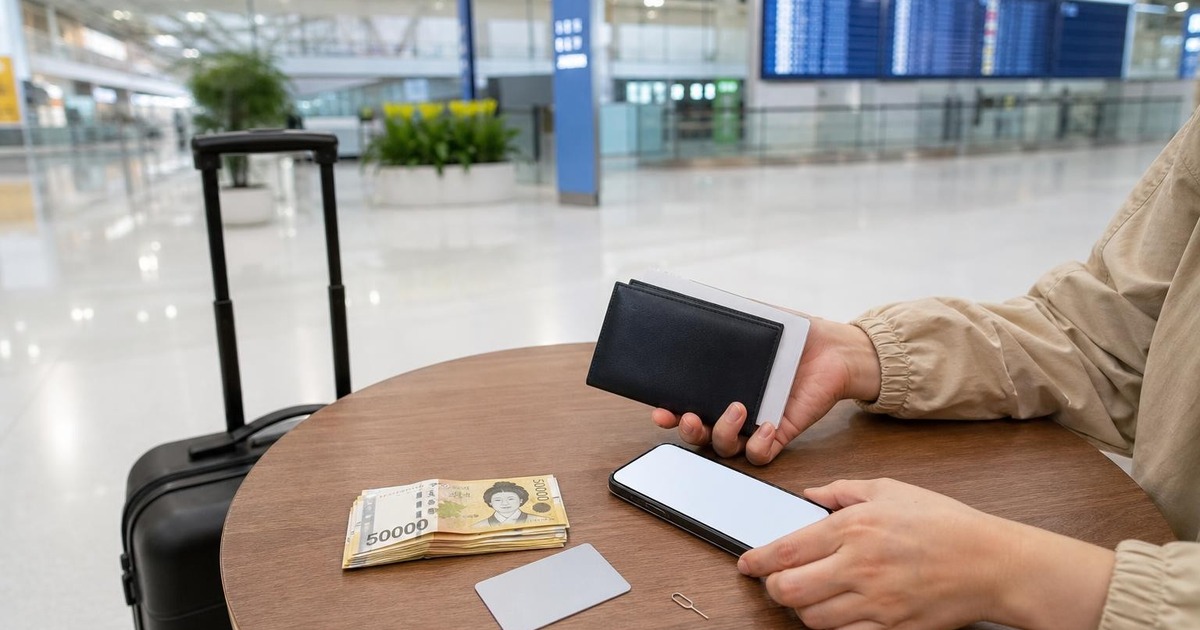
Short answer: how should first-time visitors handle arrival in Korea?
First-time visitors should treat Korea arrival as a sequence, not as one stressful airport task. The safest order is paperwork before the flight, phone data and payment setup after landing, then airport transport based on the exact hotel area. This reduces the common arrival problems: missing entry forms, no working map app, no cash for transport-card top-up, and choosing a train or bus that is not convenient for the hotel.
Do not plan arrival around a single “best” transfer. Seoul is large, and the best route from Incheon Airport changes by neighborhood. AREX can be excellent for Seoul Station and Hongdae, while an airport limousine bus can be simpler for Myeongdong, Gangnam, and hotels close to a bus stop. A taxi or ride-hailing app is worth considering when you arrive late, travel with children, carry heavy luggage, or stay far from a station.
If you want a narrower checklist for paperwork, read the Korea entry requirements guide and the e-Arrival Card step-by-step guide. This page is the broader arrival hub that connects paperwork with the first hour on the ground.
Korea arrival sequence for your first day
Stage | Main decision | Best action | Related guide |
|---|---|---|---|
Before flying | Entry paperwork | Check whether you need K-ETA, whether you are exempt, and how e-Arrival Card applies to your trip. | |
After landing | Immigration and luggage | Keep passport, arrival details, hotel address, and onward ticket information easy to access. | |
Before leaving airport | Phone and money | Activate data, withdraw or exchange a small amount of Korean won, and decide whether to buy or top up a transit card. | |
Airport to hotel | Train, bus, taxi, or k.ride | Choose by hotel area, luggage, arrival time, and transfer tolerance. | |
First evening | Recovery and backup | Save your hotel, nearest station exit, convenience store, and next-day route before going out. |
This sequence is intentionally practical. Korea is not unusually hard to enter, but the systems are specific. Visitors often lose time because they solve the right tasks in the wrong order. For example, buying a transport card before knowing whether your airport bus accepts your preferred payment method may not help. Downloading a map app after landing is possible, but it is slower than saving your hotel before the trip.
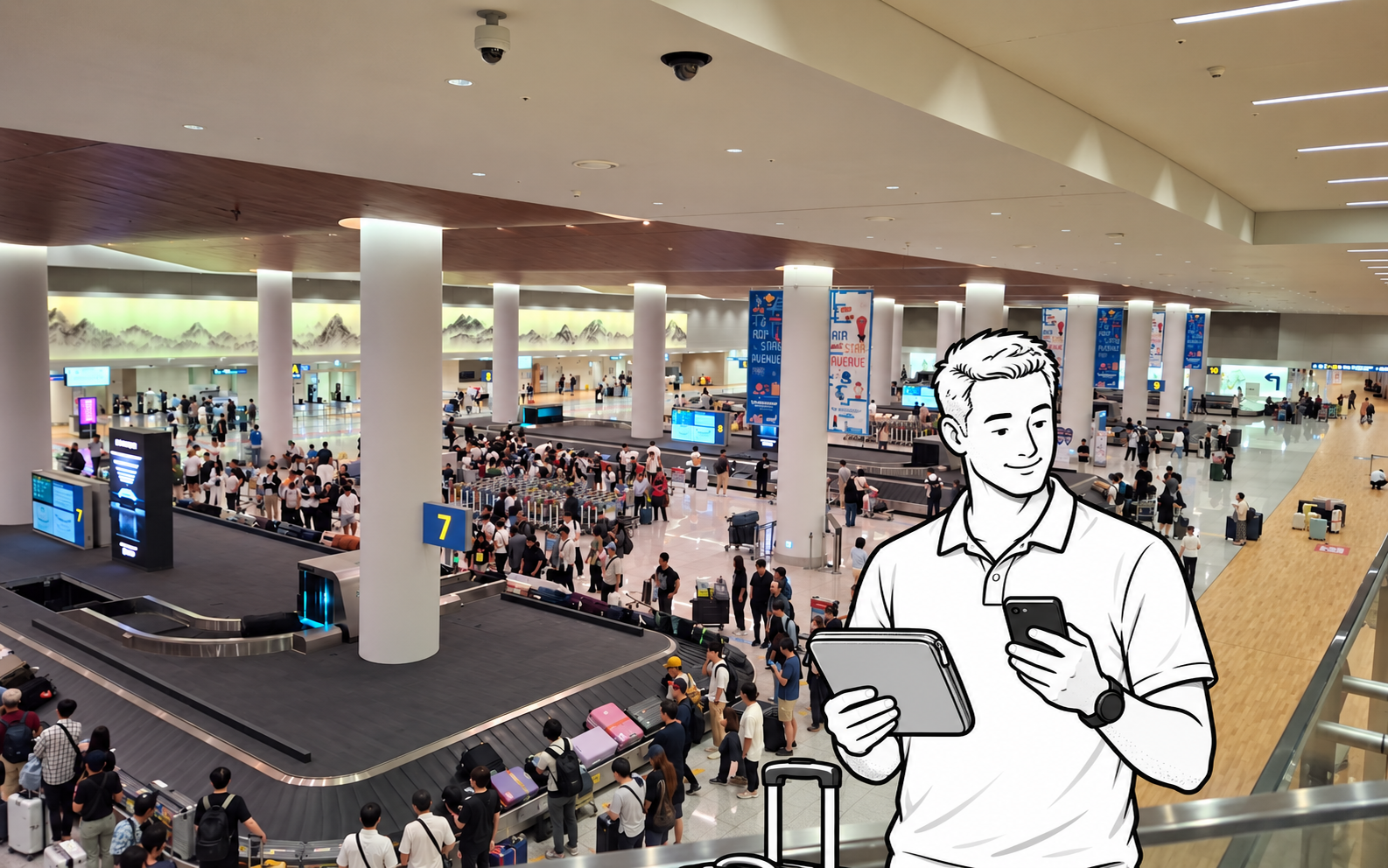
Keep your travel documents handy, collect your bags, and pause to confirm the next step before moving on.
AI-assisted photo-based composite. Baggage-hall source photographed 2024; editorial foreground illustration, not a live service map or immigration inspection scene. Background: ICN T2 arrival.jpg by AirportTerminalGuy / Wikimedia Commons, CC BY 4.0. Cropped/reframed and edited with AI-generated character overlays; small background details may differ.
Check K-ETA and e-Arrival Card rules before departure
K-ETA and e-Arrival Card are separate arrival topics. K-ETA is Korea Electronic Travel Authorization for eligible visa-free travelers who need authorization or are not covered by a temporary exemption. The e-Arrival Card is an electronic arrival declaration system. As of June 2026, travelers should check the official K-ETA and e-Arrival Card sites before flying because exemptions, form timing, and eligibility can change.
The practical rule is simple: do not rely on airline staff, social posts, or old travel forum answers for entry paperwork. Use the official pages, check your passport nationality, and keep screenshots or email confirmations where appropriate. If your country is temporarily exempt from K-ETA, you may still need to understand arrival-card requirements. If you need K-ETA, apply early enough to leave room for review or correction.
For the detailed split between authorization and arrival declaration, use K-ETA exemption in Korea for 2026 and the Korea e-Arrival Card guide. This pillar page should not replace official immigration checks.
Prepare phone data before you need navigation
Mobile data is one of the highest-leverage arrival decisions because maps, translation, taxi apps, hotel messaging, and payment checks all depend on a working phone. Most visitors should decide between roaming, eSIM, or a physical SIM before departure. The best option depends on phone compatibility, whether your device is unlocked, how many days you stay, and whether you need calls or data only.
If you choose an eSIM, confirm that your phone supports eSIM and that you understand activation timing. If you choose a physical SIM, bring a SIM tray tool and know whether pickup happens at the airport. If you use roaming, check your daily speed and price before assuming it is the easiest option. A cheap data plan that does not work at arrival is not a bargain.
Before paying, use our LG U+, SK Telecom and KT eSIM comparison to check trip duration, data, hotspot, Korean calls, activation timing and refund limits. Save the setup instructions before flying, but do not scan a QR code early if that starts the plan.
Bring or get enough Korean won for arrival basics
Korean won cash still matters for first-time visitors even if many shops accept cards. You may need cash for certain transport-card top-ups, small market purchases, backup taxi payment, or a shop where your foreign card fails. You do not need to carry a large amount, but arriving with zero cash creates avoidable risk.
A reasonable approach is to withdraw or exchange a modest amount at the airport, then use cards for larger purchases when accepted. ATMs, foreign-card acceptance, exchange rates, and card fees vary, so check your bank and avoid treating one traveler’s experience as universal. If you plan to use Tmoney heavily, remember that some top-up situations still require Korean won cash.
Use cash, cards, and ATM basics for Korea and WOWPASS vs Tmoney vs credit card before deciding how much cash to keep.
Choose the airport transfer by hotel area
The best Incheon Airport transfer is the one that gets you to your actual hotel with the least friction. AREX is strong when your hotel is near Seoul Station, Hongdae, or a convenient rail transfer. Airport limousine buses are strong when the stop is near your hotel and you want fewer stairs with luggage. Taxi or k.ride is strong when your arrival is late, your group is larger, or your hotel is awkward from a station.
For Myeongdong, compare airport limousine stops against AREX plus subway or taxi transfer. For Hongdae, AREX all-stop train to Hongik University Station is often attractive, but the final walk and station exit still matter. For Gangnam, airport buses or taxi may beat rail transfers depending on the hotel. Do not judge by travel time alone; judge by transfers, stairs, luggage, and arrival fatigue.
Use the route-specific guides for Incheon Airport to Myeongdong and Incheon Airport to Hongdae. For a broader comparison, start with AREX, airport bus, taxi, or k.ride.
Do not ignore luggage and station exits
Luggage changes the best arrival plan. A route that looks simple on a map can become tiring if it includes long station corridors, stairs, crowded transfers, or a final uphill walk. If your room is not ready, luggage storage at the airport, Seoul Station, or a station locker may be more useful than forcing sightseeing with bags.
Before arrival, check hotel check-in time and ask whether the hotel can store bags. Save the nearest station exit and the easiest walking route, not just the station name. If your first day includes Myeongdong, Hongdae, Seoul Station, or a major attraction, plan luggage storage before the flight so you are not searching while tired.
For the detailed options, use Incheon Airport and Seoul luggage storage and the airport arrival route to your Seoul hotel.
Common arrival mistakes
The most common mistake is treating Korea arrival as only an immigration task. Entry paperwork matters, but so do mobile data, Korean won, app setup, and the first hotel route. A second mistake is choosing the cheapest transfer without checking the last kilometer from station or bus stop to hotel. A third mistake is assuming every foreign card will work everywhere.
Another mistake is installing apps but not opening them. Apps may ask for language settings, phone verification, permissions, or payment setup. Open Naver Map, Papago, your taxi app, and Emergency Ready before departure. Save your hotel in Korean and English, and keep screenshots of the route and address.
FAQ
Can I arrive in Korea without cash?
It is possible, but it is not a good first-trip plan. Cards work in many places, but Korean won cash is still useful for transport-card top-ups, small vendors, backup taxi payment, and card-failure situations.
Should I buy a Tmoney card at the airport?
Buy or top up a transport card at the airport if you will use subway or bus immediately. If you take an airport bus, taxi, or hotel transfer first, you can often handle Tmoney after reaching Seoul.
Is AREX always the best way from Incheon Airport to Seoul?
No. AREX is excellent for some hotel areas, especially Seoul Station and Hongdae, but airport buses or taxis can be easier when your hotel is close to a bus stop or far from a rail transfer.
What should I save offline before flying?
Save your hotel name, Korean address, phone number, nearest station exit, first airport route, passport information backup, and entry paperwork confirmations. Screenshots matter when mobile data or app login is slow.


