
Quick summary: If you need luggage storage at Incheon Airport, look first for the official airport-listed baggage service counters such as Hanjin Express or the T-Luggage airport counter for same-day delivery. If you are already in Seoul, use a staffed T-Luggage center at major stations such as Seoul Station, Myeongdong, Hongik University, Gimpo Airport, Jamsil, or Gangnam when you have large bags, and use T-Locker subway lockers for shorter, lighter storage during station operating hours. Keep passports, laptops, cameras, cash, and valuables with you.
Best luggage storage choice by situation
Your situation | Best first choice | Why |
|---|---|---|
Long layover at Incheon Airport | Airport baggage service counter | You stay inside the airport area and avoid carrying bags into Seoul. |
Arrive before hotel check-in and want to explore | Hotel storage or T-Luggage near your first destination | Staffed storage handles larger suitcases better than small lockers. |
Hotel checkout in Seoul, evening flight from Incheon | Hotel storage, Seoul Station T-Luggage, or a station locker near your airport route | You can collect bags before taking AREX, bus, taxi, or k.ride to the airport. |
Short shopping stop in Myeongdong or Hongdae | T-Locker or T-Luggage if available nearby | You avoid dragging bags through crowded streets and subway exits. |
Oversized suitcase, stroller, or several bags | Staffed counter, not a locker | Locker size and availability are the main failure points. |
At Incheon Airport: use airport-listed baggage counters first
For storage inside Incheon Airport, start with the airport's own facility information rather than a random search result. Incheon Airport has published Hanjin Express luggage delivery and storage information, including multiple Terminal 1 and Terminal 2 counter locations and a note that operating hours can vary by terminal and location. The airport notice also tells travelers to use the Incheon Airport facility search and look for "Hanjin Express" for detailed operating hours.
This matters because airport services change more often than evergreen travel blogs imply. A counter may be open in one terminal but not another, or a late-night location may differ from a daytime location. Before relying on airport storage for an overnight layover or a same-day side trip, check the airport website, ask an information desk, or search the airport facility directory after you know your terminal.
Incheon Airport and T-Luggage information also lists airport-linked luggage delivery options. These can be useful when you want to send bags between an airport counter and selected Seoul station counters, but they are not the same as simply putting a bag into a locker. Delivery has cut-off times, pickup windows, and flight-related rules, so confirm the route before paying.
At Seoul Station: choose between T-Luggage and lockers
Seoul Station is the most useful storage point if your day ends with AREX to Incheon Airport, KTX, or a central-Seoul transfer. The official T-Luggage site lists the Seoul Station center at B1, in the direction from Exit 1 to Exit 2, with business hours shown as 09:00 to 22:00. This is a staffed option, so it is usually better for larger suitcases than a locker.
Seoul Station also has locker options, but travelers should treat lockers as capacity-limited. Large lockers can fill up, and some lockers require app or kiosk steps that may be awkward if your phone battery is low, your card fails, or the interface is Korean-first. If missing your airport train would be a serious problem, do not leave locker collection to the last possible minute.
T-Luggage: staffed storage and delivery at major stations
T-Luggage is the storage and delivery service tied to major Seoul station locations. The official English site describes luggage storage and delivery at major stations, and lists centers including Seoul Station, Myeongdong Station, Hongik University Station, Gimpo Airport Station, Jamsil, and Gangnam. VisitKorea also lists T-Luggage as a tourist-facing service with online booking and service locations including Seoul Station, Myeongdong, Hongik University, Jongno 3-ga, Jamsil, Suseo, and more.
For a first-time visitor, T-Luggage is most useful when you want a human counter and a clear pickup point. Use it when you have a large suitcase, want same-day delivery, or do not want to gamble on locker size. The tradeoff is that business hours and delivery cut-off times matter. If you arrive outside counter hours, the service may not solve your problem.
As of the official T-Luggage site checked on June 5, 2026, the Seoul Station, Myeongdong, Hongik University, Jamsil, and similar staffed station centers are shown with 09:00 to 22:00 business hours. The airport-related T-Luggage page lists Incheon Airport Terminal 1 and Terminal 2 counters with airport counter hours, but those details should still be checked on the travel day because airport counters and delivery partners are operationally sensitive.
T-Locker: subway lockers for shorter storage
T-Locker is Seoul Metro's subway locker service. The Seoul Metropolitan Government storage facilities page describes T-Locker as a storage service in subway stations and lists locker sizes for small, medium, and large lockers. It also lists base rates for the first four hours, with different weekday and weekend rates and extra hourly charges.
T-Locker is best for a backpack, shopping bags, a carry-on, or a medium suitcase when you are staying close to the station. It is not the best choice for every airport day. A large suitcase may not fit, large lockers may be full, and storage or retrieval is unavailable outside operating hours. If your flight is late at night or early in the morning, check access hours before leaving your bag.
The practical rule is simple: use lockers for short, flexible storage; use a staffed counter for large luggage, delivery, or a strict airport timeline.
Myeongdong and Hongdae storage
Myeongdong and Hongdae are common luggage-storage pain points because many visitors arrive before hotel check-in or check out before an evening flight. The official T-Luggage site lists a Myeongdong Station center at B1 near Exits 1, 9, and 10, and a Hongik University Station center in the B1 Airport Railroad connecting passage. These are helpful if your hotel will not hold bags or if you want to explore before moving to another area.
Before choosing a storage point, check walking distance with a Korea-friendly map app. A station name can hide a long walk through stairs, hills, crowds, or underground corridors. For map setup and station-exit habits, use How to use Naver Map in Korea when Google Maps is not enough.
What not to store
Do not store your passport, immigration paperwork, credit cards, cash, laptop, camera, medicine, jewelry, house keys, or anything you cannot afford to lose or delay. T-Luggage terms specifically prohibit or warn against valuable items such as laptops, cameras, tablet PCs, cash, jewelry, ID cards, passports, keys, fragile items, perishables, animals, plants, flammable items, weapons, and illegal items. Even when a locker or counter looks safe, your travel day becomes fragile if your passport or medication is separated from you.
Keep a small personal bag with your passport, wallet, phone, charger, medication, flight details, and hotel address. If you are storing a suitcase before going sightseeing, take a photo of the bag, the claim ticket or locker number, and the storage area entrance.
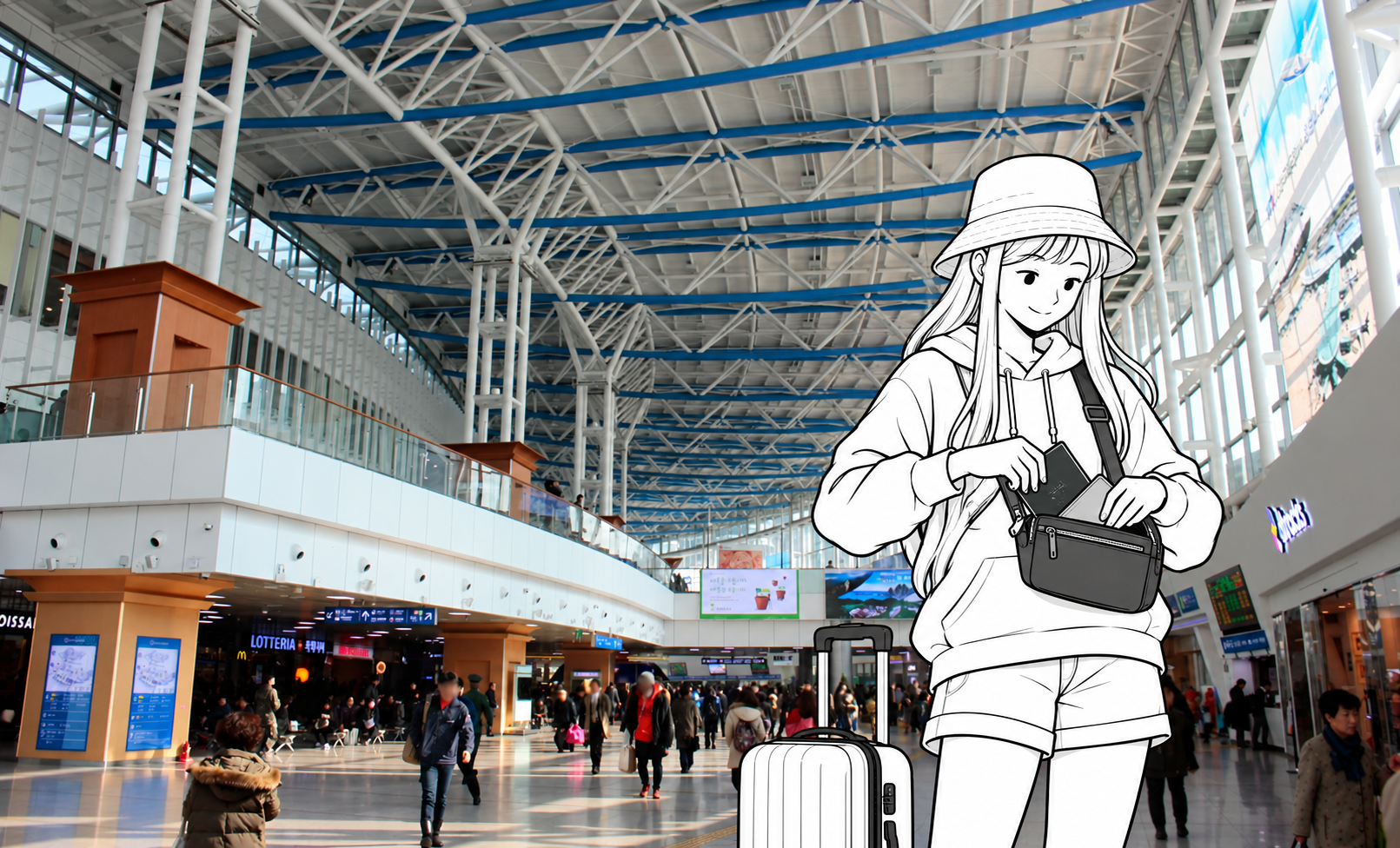
Before storing your suitcase, keep your passport, wallet, phone, and other essentials in a bag that stays with you.
AI-assisted photo-based composite. Seoul Station concourse photo from 2014. The image is not a storage-counter location or current locker map. Background: Seoul Station Concourse.jpg by Minseong Kim / Wikimedia Commons, CC BY-SA 4.0. Cropped/reframed and edited with AI-generated character overlays; small background details may differ. Derivative illustration under CC BY-SA 4.0.
Storage before hotel check-in
If your flight lands in the morning and your hotel check-in is not until the afternoon, your easiest option may still be the hotel. Many hotels will hold bags for arriving guests, but policies vary by property and crowding. Ask in advance if you are staying at a small guesthouse, apartment-style room, or unmanned accommodation.
If your hotel is far from your first sightseeing area, do not travel across Seoul just to leave luggage unless it saves you effort later. For example, if you land at Incheon and plan to spend the afternoon in Myeongdong, a Myeongdong-area storage counter can make more sense than going to a hotel in another district first. If you are using the airport transfer route into central Seoul, compare your storage plan with Incheon Airport to Myeongdong and AREX, airport limousine, taxi, or k.ride: best way from Incheon to Seoul.
Storage after hotel checkout
After checkout, use the place that best matches your airport route. If you are leaving by AREX, Seoul Station storage is convenient. If you are using airport limousine bus 6015 from Myeongdong, storage near Myeongdong can work as long as you can retrieve bags before the useful bus window. If you plan to use taxi or k.ride, hotel storage is often simplest because the car can pick you up near the hotel.
Build in extra time for retrieval. A locker queue, app issue, misplaced claim ticket, full elevator, or crowded station can turn a comfortable airport departure into a rushed one. For airport departure days, collect luggage earlier than you think you need to.
Delivery from station to airport
T-Luggage and airport-linked delivery services can be useful if you want to explore without returning to the original station. The official service pages describe online reservation, on-site registration, delivery cut-off times, airport pickup times, and station pickup windows. This is convenient, but it adds operational risk: your delivery depends on the correct drop-off location, correct flight details when required, the cut-off time, and the pickup counter being open.
Use delivery when your schedule has buffer time. Avoid it when you are on a tight same-day international departure, carrying essential items, or unsure whether your airline and route fit the service rules.
Step-by-step plan for first-time visitors
Decide whether you need airport storage, station storage, hotel storage, or delivery.
Keep valuables and essential documents in a personal bag.
Check the official counter hours or locker access hours for the exact station or terminal.
Confirm whether your suitcase will fit if using a locker.
Take photos of your bag, claim ticket, locker number, and nearby station exit.
Set an alarm for retrieval with at least 30 to 60 minutes of buffer before your next transport.
Common mistakes
Assuming every station has large lockers available. Large lockers are limited and can fill up.
Storing a passport or laptop because the storage point looks secure. Keep essential and valuable items with you.
Choosing a locker outside your real route, then spending more time retrieving bags than you saved.
Relying on airport storage hours from an old blog post. Airport counters can change location or hours.
Using delivery on a tight flight day without checking cut-off and pickup times.
How this fits your arrival plan
Luggage storage is usually part of a bigger arrival or departure sequence. If you are landing at Incheon, first decide how you will get to Seoul, whether you need a SIM or eSIM, and whether you need cash before leaving the airport. Start with Incheon Airport arrival route: from plane seat to Seoul hotel and Where to buy a transport card, SIM, eSIM, and cash at Incheon Airport. If you are using your first free afternoon in Seoul after dropping bags, Your first 72 hours in Seoul can help you keep the day realistic.
Use the planning hub for the bigger decision
This page answers a specific travel problem. Use the related hub guide when you need the broader arrival, transport, Seoul, money, or app-planning context.
Bottom line
Use Incheon Airport baggage counters for airport layovers, T-Luggage for staffed storage or delivery at major Seoul stations, and T-Locker for short station-based storage when your bag fits and the station hours work. The safest plan is the one with the fewest retrieval risks: keep valuables with you, choose a storage point on your real route, and leave enough time to collect your bags before the next train, bus, taxi, or flight.


