
Quick summary: For most foreign visitors, Korea is card-friendly but not cash-free. Bring at least one international credit or debit card, keep a second backup card separate from your wallet, and get some Korean won cash for transit top-ups, small vendors, markets, and ATM or card failures.
Use cards for: hotels, larger restaurants, cafes, convenience stores, department stores, many attractions, and many taxis.
Keep cash for: Tmoney top-ups, street food, traditional markets, small local shops, older machines, deposits, and emergencies.
Use ATMs carefully: airport and bank ATMs are useful, but not every machine accepts every overseas card. Test one withdrawal early and do not rely on a single card.
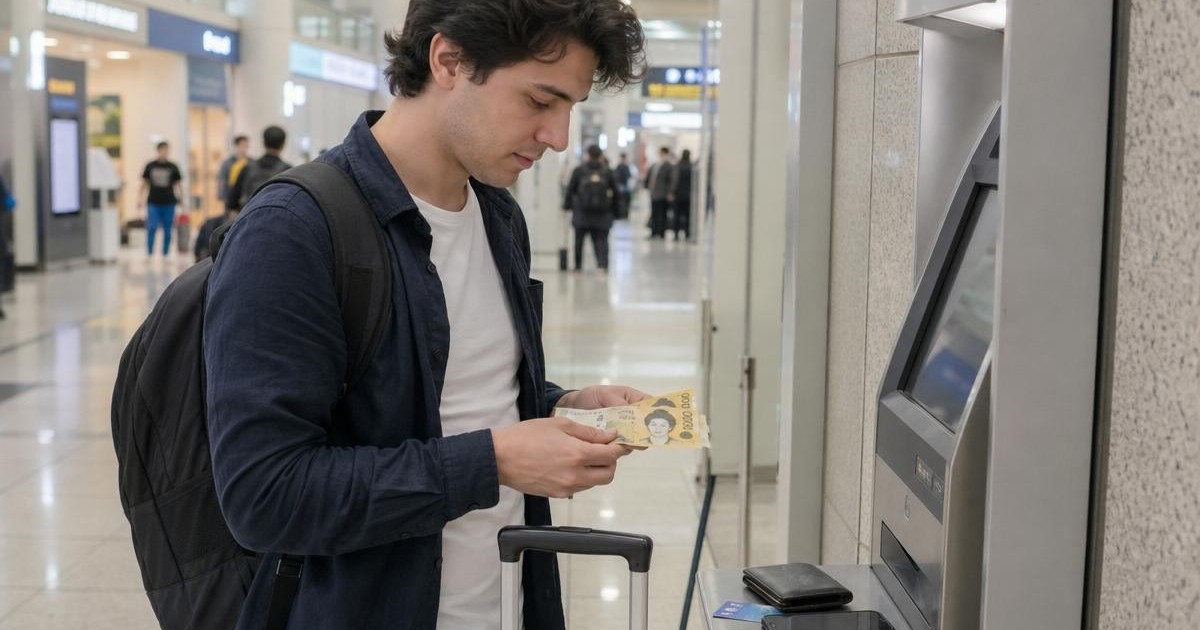
Can tourists use credit cards in Korea?
Yes. For a normal first trip to Korea, an international credit card or debit card should handle most everyday spending in Seoul, Busan, Jeju, and other major visitor areas. Hotels, department stores, chain cafes, convenience stores, major attractions, and many restaurants are used to card payments.
The practical warning is that "card-friendly" does not mean "your card will work everywhere." A foreign-issued card can still fail at a small merchant, an unmanned kiosk, a parking payment machine, a local booking site, or a store terminal that is not set up well for overseas cards. Some merchants may also ask you to insert the chip instead of tapping.
The safest setup is simple: carry one primary no-foreign-transaction-fee card, one backup card from a different network or bank if possible, and enough Korean won cash to keep moving if a payment terminal refuses your card.
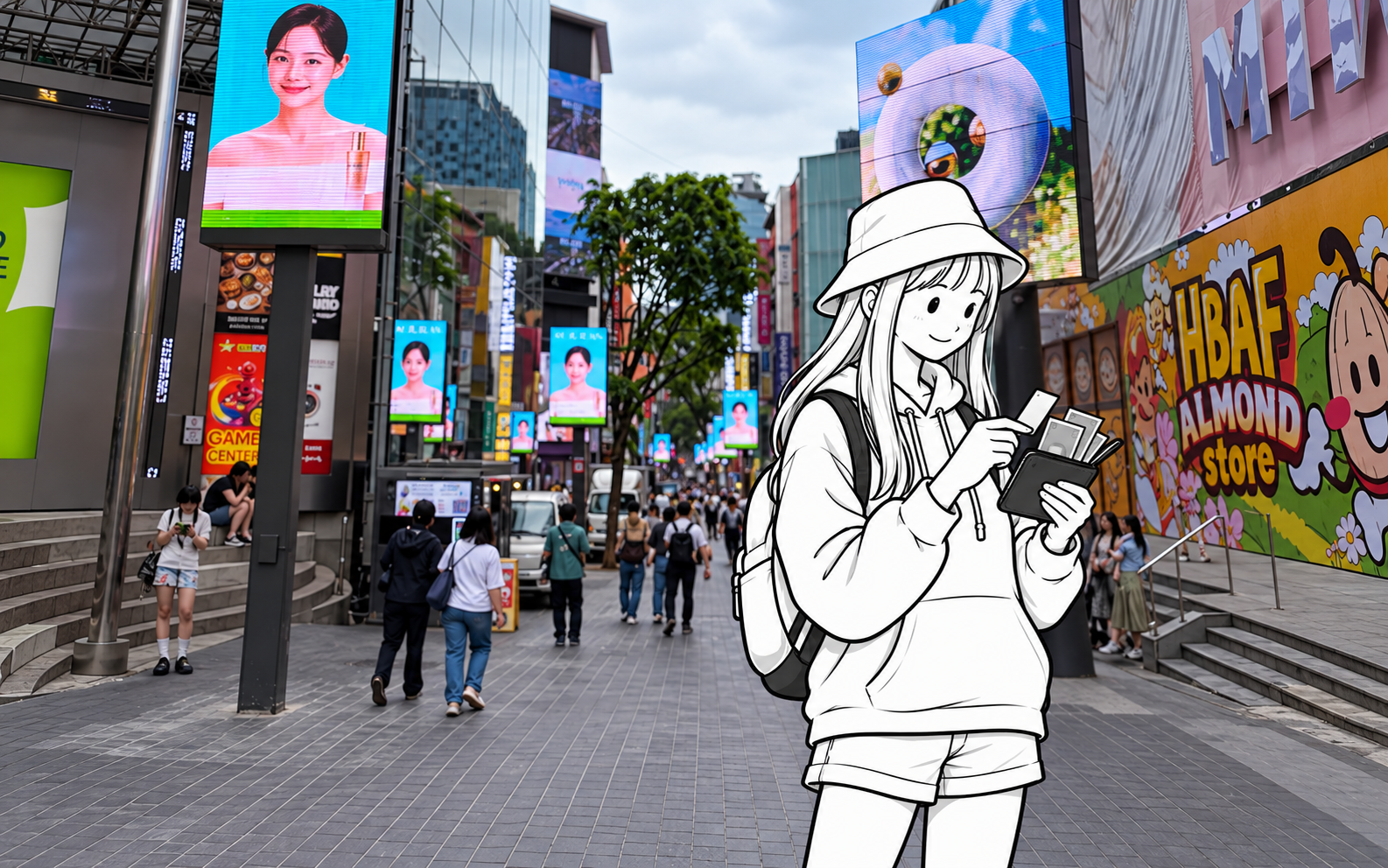
Carry a usable card and a little cash, and keep your backup card separately.
AI-assisted photo-based composite. Generic illustrated cash and card; no bank or ATM interface is depicted. Background: Myeongdong street.jpg by Izzatfikry99 / Wikimedia Commons, CC BY 4.0. Cropped/reframed and edited with AI-generated character overlays; small background details may differ.
How much cash should you carry in Korea?
You do not need to carry a large stack of cash for a short Korea trip. For most visitors, a small working amount is enough: cash for your first transit top-up, a few snacks or market purchases, and a backup taxi or meal payment. Many travelers are comfortable starting with 50,000 to 100,000 KRW in smaller bills, then withdrawing more only if they actually need it.
Try to keep small denominations. A 50,000-won note is useful for larger withdrawals, but 1,000, 5,000, and 10,000-won notes are easier for transport card top-ups, street food, lockers, small shops, and splitting costs with friends.
Do not bring an unusually large cash amount unless you have a clear reason. If you enter Korea with currency or other payment means over the USD 10,000 equivalent threshold, declaration rules may apply. For normal tourist spending, using cards plus small KRW cash is easier and safer.
When cash still matters
Cash matters most when the payment system is local, small, or transit-related. The biggest surprise for many visitors is not restaurants. It is transportation card top-up. If you are using a physical Tmoney card, the official Tmoney foreigner guide says to present the card and Korean won cash at Tmoney sales locations for top-up. Subway top-up machines and convenience store counters are common options, but you should not assume that an overseas credit card can recharge a physical Tmoney card.
Cash can also be useful in traditional markets, street food areas, smaller guesthouses, rural shops, small family-run restaurants, coin lockers, older vending machines, and informal situations where card terminals are unavailable or inconvenient. Korea has many card payments, but visitor friction usually appears in exactly these edge cases.
If your trip includes Seoul only, you may use cash less often. If your trip includes regional buses, small towns, markets, guesthouses, hiking areas, or older local businesses, keep a little more Korean won available.
Where should you get Korean won?
You have three normal options: withdraw Korean won from an ATM, exchange foreign cash at an authorized exchange counter, or use a prepaid visitor card system. The best choice depends on your bank fees, your arrival time, and how comfortable you are handling cash.
At Incheon Airport, bank counters, currency exchange counters, and ATMs are listed across the terminals. This makes the airport a practical place to get enough cash for the first day, even if you plan to look for better rates later. The tradeoff is convenience versus rate. Airport exchange counters are easy after a long flight, but they may not be the cheapest option for a large exchange.
In Seoul, foreign currency can be exchanged at airport bank offices, downtown banks, and authorized private exchange offices. Bring your passport or residence card when exchanging currency, because identity checks may be required. Avoid unofficial exchange offers, especially around airports or crowded tourist areas.
How to use ATMs with a foreign card
Plan your first ATM withdrawal before you are completely out of cash. If one machine rejects your card, try a bank ATM, another bank, or a machine in a different location. A rejection does not always mean your bank account has a problem; it can be a machine, card network, account type, daily limit, or security setting issue.
Before flying, tell your bank you are traveling if your bank still uses travel notices. Check your cash withdrawal limit, foreign transaction fee, ATM operator fee policy, and cash advance rules. If you use a credit card at an ATM, it may be treated as a cash advance, which can be expensive. A debit card tied to your checking account is usually the cleaner ATM tool.
At the machine, read the English screen carefully. Decline unnecessary dynamic currency conversion if the ATM offers to convert the transaction into your home currency at its own rate. In most cases, letting your card network or bank handle the conversion is cleaner, but your own bank's fee structure still matters.
Can you use only cash in Korea?
You can pay with cash in many places, but cash-only travel is no longer the easiest plan. Some kiosks, online bookings, accommodations, ticketing systems, and modern stores are built around cards. A few places may strongly prefer card payment even for small purchases.
If you dislike using credit cards abroad, consider bringing a low-fee debit card and using cash for daily spending. Still keep one international card for hotels, deposits, emergency purchases, online reservations, and situations where cash is inconvenient or refused.
Can you use only cards in Korea?
You can get close in central Seoul, but you should not plan a zero-cash trip. The weak points are transit-card recharge, street food, traditional markets, small local businesses, some older machines, and moments when a foreign card does not read correctly. A small cash reserve prevents a minor payment failure from becoming a lost afternoon.
If you want a low-cash setup, do this on arrival: withdraw or exchange a small KRW amount, buy and load your transit card, then use your card for most purchases. The goal is not to spend cash everywhere. The goal is to have cash exactly when the Korean payment system expects it.
Arrival-day payment setup
Before flying: pack two payment cards, check ATM limits, and save your bank's international support number offline.
At the airport: get a small amount of Korean won from an ATM or authorized exchange counter if you do not already have KRW.
Before leaving the airport or first station: buy and load a Tmoney or other transport card if you plan to use subway or bus.
At your first convenience store: test a small card purchase. This confirms whether your primary card works for chip payments in Korea.
At your hotel: store your backup card separately from your daily wallet.
If you are landing at Incheon and still deciding what to buy first, read where to buy a transport card, SIM, eSIM, and cash at Incheon Airport. If you are choosing your airport transfer, compare AREX, airport limousine buses, taxis, and k.ride from Incheon to Seoul.
Common payment mistakes
Assuming transit works like London or Singapore: most visitors still need a Korean transport card or a ticket for subway and bus travel. Do not expect your overseas credit card to work directly at every gate.
Landing with no cash at all: even a small KRW amount helps with Tmoney, snacks, local buses, or an ATM problem.
Keeping only one card: if your one card is blocked, damaged, or rejected, you lose your backup plan.
Withdrawing too much at once: Korea is not a place where visitors usually need to carry large cash. Withdraw in practical amounts.
Confusing Tmoney balance with shopping card balance: prepaid visitor cards and transit cards can have separate balances. Check the details before loading money.
Best setup by travel style
First-time Seoul visitor: Use an international credit card for most purchases, a Tmoney card for transit, and a small cash reserve. This is the simplest setup for subway, convenience stores, cafes, and attractions.
Family or group trip: Carry more small bills than a solo traveler. You may need cash for multiple Tmoney top-ups, market snacks, lockers, or splitting small costs. Keep one backup card with another adult.
Regional trip: Keep more cash than you would in central Seoul. Cards still work in many places, but small towns and older local businesses can be less predictable.
Low-fee card user: If your card has no foreign transaction fee and works well in Korea, use it for most purchases. Keep cash only for transit top-up and edge cases.
Cash-first traveler: You can use cash often, but keep a card for hotels, deposits, reservations, and card-preferred businesses. Korea is easier with both.
Related Korea Travel 101 guides
Tmoney top-up reality check: why cash still matters in Korea transit
Where to buy a transport card, SIM, eSIM, and cash at Incheon Airport
AREX, airport limousine, taxi, or k.ride: best way from Incheon to Seoul
Use the planning hub for the bigger decision
This page answers a specific travel problem. Use the related hub guide when you need the broader arrival, transport, Seoul, money, or app-planning context.


