
Quick answer: Finish decisions that can affect boarding as soon as your itinerary is firm. Complete any required arrival declaration from three days before you arrive in Korea, based on Korean Standard Time. After landing, follow one order: current entry instructions, immigration, baggage claim, customs, connectivity, then transport.
- As soon as you book: determine which entry-document path applies and start any authorization that needs review.
- From three days before arrival: submit the free e-Arrival Card if the official navigator says you need one.
- Before boarding: save your hotel details, confirmations, and airport route offline.
- After landing: clear the border and collect your bags before shopping for travel products.
Live notice checked September 21, 2026: The official K-ETA homepage currently displays a special-entry declaration notice for foreign arrivals. It is separate from the ordinary K-ETA and e-Arrival Card rules. Reopen the official K-ETA homepage shortly before departure and follow the notice shown for your travel date.
Use this checklist as a timeline
This guide assumes you already know which entry documents apply to you. If you do not, start with the Korea entry requirements guide. It separates visas, K-ETA, and arrival declarations. Once that decision is settled, return here and work through the tasks in order.
The goal for your first airport hour is equally narrow: clear immigration, retrieve your baggage, handle customs, confirm that your phone and hotel route are usable, and leave on the transport you already chose. Immigration queues and baggage delivery vary, so treat “first hour” as the sequence to follow rather than a guaranteed finish time.
As soon as your flight and accommodation are firm
- Check the correct entry-document path. Run the check for every traveler, especially when a group uses different passports or has different travel purposes.
- Start K-ETA early if it is required or you choose to apply voluntarily. The official guide says review usually takes 72 hours or less, may take longer, and has no expedited service.
- Check the passport you will actually use. The passport on your booking, authorization, and entry record needs to match.
- Save your first accommodation details. Keep the hotel name, Korean address, phone number, check-in time, and nearest practical station exit together.
- Choose an airport-to-hotel route and one backup. Make the choice around your terminal, arrival time, luggage, and final walk rather than price alone.
For temporary exemption details and the choice between a free arrival declaration and voluntary K-ETA, use the 2026 K-ETA exemption guide. This checklist does not repeat that decision.
From three days before you arrive in Korea
If the official e-Arrival Card navigator says you need an arrival declaration, the online filing window opens three days before arrival based on Korean Standard Time. It is not calculated from your departure date. Submission is free on the official government site.
An e-Arrival Card remains valid for 72 hours after submission and also ends once you have completed immigration. If your purpose of entry, accommodation, or departure date changes before immigration, edit the submission on the official site. You do not need to bring a printed copy to inspection, although keeping the issue number and confirmation offline can be useful.
The electronic and paper arrival cards have the same effect under the current official guide. If you need the field-by-field process, editing rules, or group-submission limits, use the Korea e-Arrival Card guide.
The night before your flight
Create one offline arrival folder on your phone. Do not rely on open browser tabs or airport Wi-Fi.
- passport details stored securely;
- visa or K-ETA confirmation if applicable;
- e-Arrival Card issue number or confirmation if applicable;
- the current special-entry notice or airline instructions that apply to your flight;
- hotel name, Korean address, phone number, and booking confirmation;
- arrival terminal, flight number, and baggage allowance from your e-ticket;
- primary airport route, backup route, and hotel map pin;
- travel-insurance and emergency-contact details.
Charge your phone and power bank, download any eSIM instructions you may need, and keep the first hotel's address somewhere you can show without unlocking several apps.
At the departure airport
- Use the same passport you used for the booking and any K-ETA application.
- Keep the passport and any airline-requested entry confirmation in your cabin bag.
- Check your arrival terminal again because codeshares and airline operations can change it.
- Confirm that your phone will have data after landing, or keep the activation instructions offline.
- Reopen the live K-ETA notice if a special-entry instruction is active.
Do not submit a second form simply because an unofficial website or sponsored search result looks urgent. The official e-Arrival Card is free, and the official K-ETA site warns about agencies and phishing pages that charge high fees.
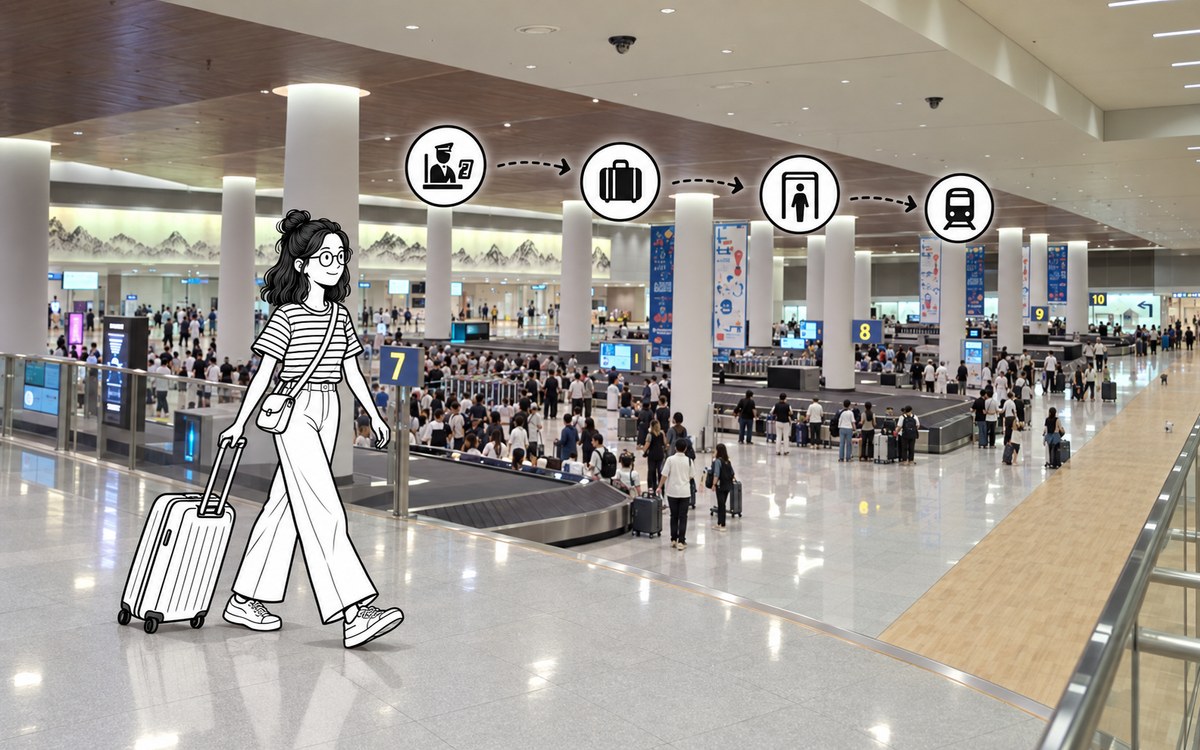
After landing: follow the airport sequence
At Incheon Airport, the official arrival flow moves from the aircraft or concourse toward entry instructions and immigration, then baggage claim, customs, and the arrival hall. Other Korean international airports use the same basic border sequence, but follow the signs and staff instructions at the airport where you land.
- Follow current declaration and quarantine instructions. Use the live instructions for your travel date. Do not assume an ordinary K-ETA or arrival-card rule cancels a separate temporary notice.
- Clear immigration. Have your passport ready. Retrieve an offline confirmation only if an officer or the process requires information from it.
- Check the baggage carousel and collect every bag. Report missing or damaged baggage to the airline before leaving the controlled baggage area.
- Pass customs. If you have goods or currency that must be declared, use the appropriate declaration process and Goods to Declare lane. The customs declaration is separate from the immigration arrival card.
- Enter the arrival hall. Only now handle the minimum setup needed to reach your accommodation.
In the arrival hall: solve only what you need
- Confirm mobile data. If roaming or your eSIM already works, skip the telecom queue. If it does not, use the airport option you planned.
- Open the saved hotel route. Check the terminal, service hours, stop or station, and final walk before buying a ticket.
- Get a small cash buffer only if your route needs it. Do not exchange or withdraw a large amount simply because you have reached the airport.
- Buy or top up a transport card only if you will use local transit immediately. A direct airport bus or taxi may let this wait.
- Go to the correct transport area. Follow official signs for rail, airport bus, or taxi rather than accepting an unsolicited ride.
Use the SIM, eSIM, and roaming guide for connectivity, the Korea money and payment guide for cash and cards, and the Incheon-to-Seoul transport comparison for the route decision.
What can wait until the hotel?
- buying sightseeing passes you will not use that day;
- installing every recommended Korea app;
- exchanging your full travel budget;
- planning the next several days in detail;
- choosing a long-term transport pass before you know your actual routes.
Once you reach the hotel, save the nearest useful station exit, check the next morning's route, and put your passport somewhere secure. The broader first-time Korea arrival guide continues from there.
One-screen Korea arrival checklist
- After booking: settle visa/K-ETA/arrival-declaration eligibility, start any authorization, save the hotel address, and choose airport transport.
- Three days before arrival: submit the e-Arrival Card if required and check the live special-entry notice.
- Night before flying: build the offline folder, charge devices, and confirm the arrival terminal.
- After landing: current instructions → immigration → baggage → customs → arrival hall.
- Before leaving the airport: confirm data and your hotel route; add cash or a transport card only when the route requires it.
Sources
- Official K-ETA homepage: current special-entry notice, official application access, and phishing warning
- Official K-ETA application guide: usual review time, possible delays, and no expedited service
- Official e-Arrival Card guide: three-day filing window, 72-hour validity, edits, issue number, and electronic/paper equivalence
- Official e-Arrival Card homepage and eligibility navigator
- Incheon International Airport: official arrival procedures from aircraft to arrival hall
- Incheon International Airport Customs: declaration lanes, mobile declaration, and traveler guidance
- Korea Customs Service: official passenger customs guidance
Entry paperwork and airport procedures checked September 21, 2026; next routine review due October 21, 2026. Recheck the live K-ETA homepage on publication day because the current special-entry notice may change independently of the ordinary entry workflow.
Image credits: cover background, Incheon International Airport Terminal 1 Departure by Arne Müseler, CC BY-SA 3.0 DE; preflight background, Incheon airport departure gate access by Sgroey, CC BY-SA 4.0; offline-folder background, Incheon airport arrivals queue by Sgroey, CC BY-SA 4.0; arrival-hall background, ICN T2 arrival by AirportTerminalGuy, CC BY 4.0. Cropped and composited with original Mina line art by Korea Travel 101. Adapted images retain the applicable source licence.


