
Quick summary: Take the AREX All-Stop train if your hotel is near Hongik University, Gongdeok, or Seoul Station and you can manage your bags. Take the Express if Seoul Station is genuinely your final hub. Choose an airport bus when it stops within a short walk of your hotel. Choose a taxi for a late arrival, several large bags, children, or a group that can split the fare. k.ride is a way to book and pay for a taxi, not a separate type of transport.
Lowest rail fare: AREX All-Stop (₩4,750 from T1 or ₩5,350 from T2 to Seoul Station, but there are no reserved seats)
Fastest to Seoul Station: AREX Express (43 minutes from T1 or 51 minutes from T2, ₩13,000, but it skips Hongdae and Gongdeok)
Least luggage handling: airport limousine bus (usually ₩17,000–₩18,000, but only if the stop is close to your hotel)
Most direct: taxi (door to door, but traffic, tolls, vehicle size, and night surcharges affect the price)
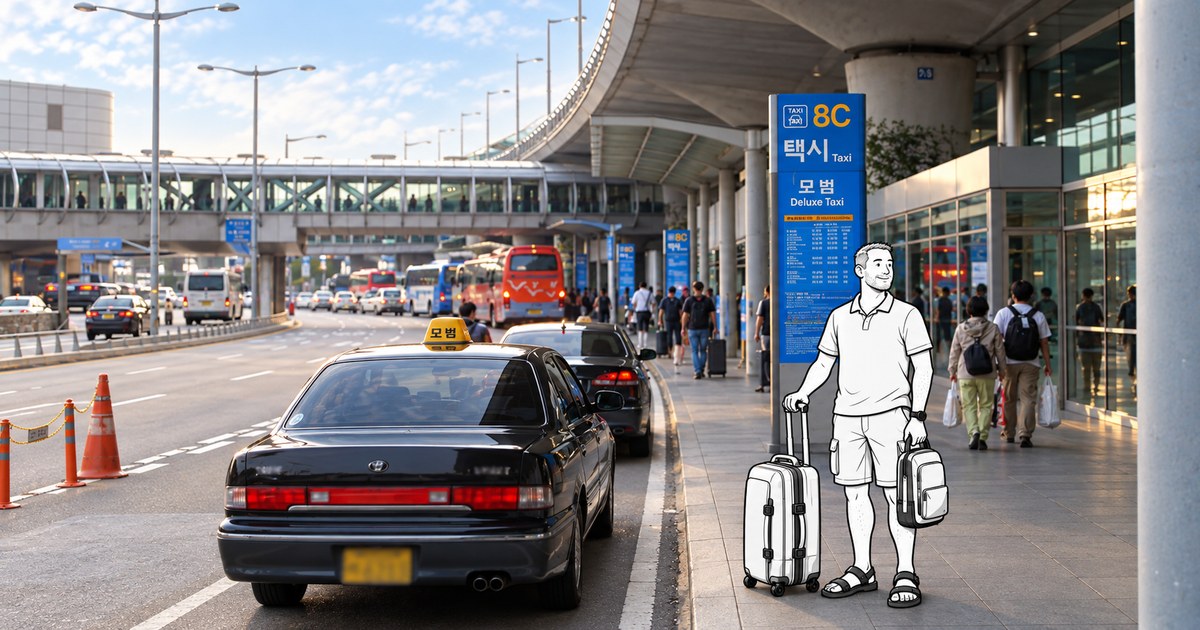
Short answer: what is the best way from Incheon Airport to Seoul?
For most first-time visitors, the best option is the one that leaves the least difficult final leg. A fast train is a poor choice if it leaves you with a long subway transfer and two suitcases. A slower bus can be better if it stops outside your hotel. A taxi can be good value for three or four people even though it is expensive for one.
Check your exact hotel address before choosing. Measure the walk from the station or bus stop, look for transfers and station exits, and decide whether you can handle that route after a long flight. The airport-to-Seoul time is only part of the trip.
Who this guide is for
This guide is for visitors traveling from Incheon Airport Terminal 1 or Terminal 2 to a hotel in Seoul. It assumes you already know your hotel address and want to compare the main public-transport and taxi choices. If you are going specifically to Myeongdong or Hongdae, use the route-specific guides linked below because the best answer is different for each area.
Compare the options
Option | Current cost | Best for | Main drawback |
|---|---|---|---|
AREX Express | ₩13,000 | Seoul Station, reserved seat, predictable trip | Nonstop to Seoul Station only; you may still need a taxi or subway |
AREX All-Stop | T1 ₩4,750 / T2 ₩5,350 to Seoul Station | Hongdae, Gongdeok, budget travel, useful transfers | More stops, no reserved seat, and less pleasant with large bags when crowded |
Airport bus | Usually ₩17,000–₩18,000 | Hotels close to a bus stop, Gangnam, families, large luggage | Traffic and a poor final walk can cancel the convenience |
Regular taxi | Metered fare plus toll; higher at night | Door-to-door travel, groups, children, mobility needs | Traffic, toll, night surcharge, and luggage capacity |
Taxi through k.ride | Estimate shown before booking | Foreign-card payment, translated search and chat, airport pickup reservation | You still need the correct pickup point and the right vehicle size |
Compare the total for your group
Multiply tickets by the number of travelers before comparing them with a car quote. These are one-way adult totals in Korean won, with no promotional discounts:
Service | 2 adults | 3 adults | 4 adults |
|---|---|---|---|
All-Stop, T1 to Seoul Station | ₩9,500 | ₩14,250 | ₩19,000 |
All-Stop, T2 to Seoul Station | ₩10,700 | ₩16,050 | ₩21,400 |
Express to Seoul Station | ₩26,000 | ₩39,000 | ₩52,000 |
Airport bus 6001 or 6015 | ₩34,000 | ₩51,000 | ₩68,000 |
The All-Stop rows use AREX's adult transport-card fares; card purchase costs are excluded. The Express fare and 6015/6001 bus fares are published by their operators. Rail totals end at Seoul Station. Add the cost and effort of reaching your hotel before comparing them with a door-to-door ride.
A group does not automatically make a taxi cheaper. Compare the total car price, including any tolls, booking charges and late-night fees, with the tickets you would actually buy. Then check whether that vehicle fits every passenger and bag. A larger vehicle may change the calculation.
Choose AREX when your hotel fits the rail line
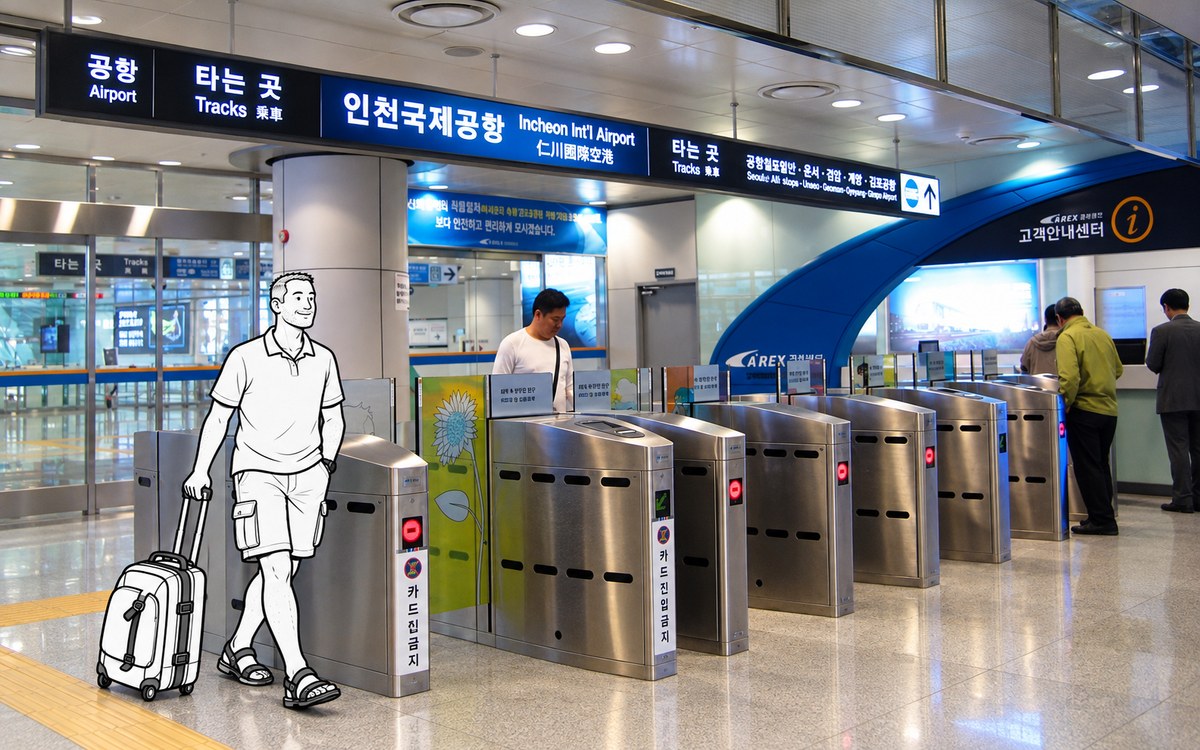
The Express and All-Stop trains serve different trips. The Express runs nonstop to Seoul Station in 43 minutes from Terminal 1 or 51 minutes from Terminal 2. The current ordinary price is ₩13,000, and the ticket includes a reserved seat. It makes sense when Seoul Station is your destination or when you plan to take a short taxi from there.
The All-Stop train takes about 59 minutes from T1 or 66 minutes from T2 to Seoul Station. It costs ₩4,750 from T1 or ₩5,350 from T2. It also stops at Hongik University, Gongdeok, Digital Media City, Gimpo Airport, and other transfer stations. For a Hongdae hotel, the All-Stop train is usually more useful than paying extra for the Express and then traveling back across the city.
The trade-off is luggage. The All-Stop train works like urban rail, so there are no reserved seats and it can be busy. Seoul Station is also large. Before choosing either train, check the route from the platform to your next subway line, station exit, or taxi pickup point.
Buy the right ticket: the Express needs its own ticket before boarding. The All-Stop accepts transport cards. The quoted times are station-to-station; some All-Stop services take another 2–6 minutes, and your wait for the train and hotel transfer come on top.
Choose an airport bus when the stop is close to your hotel
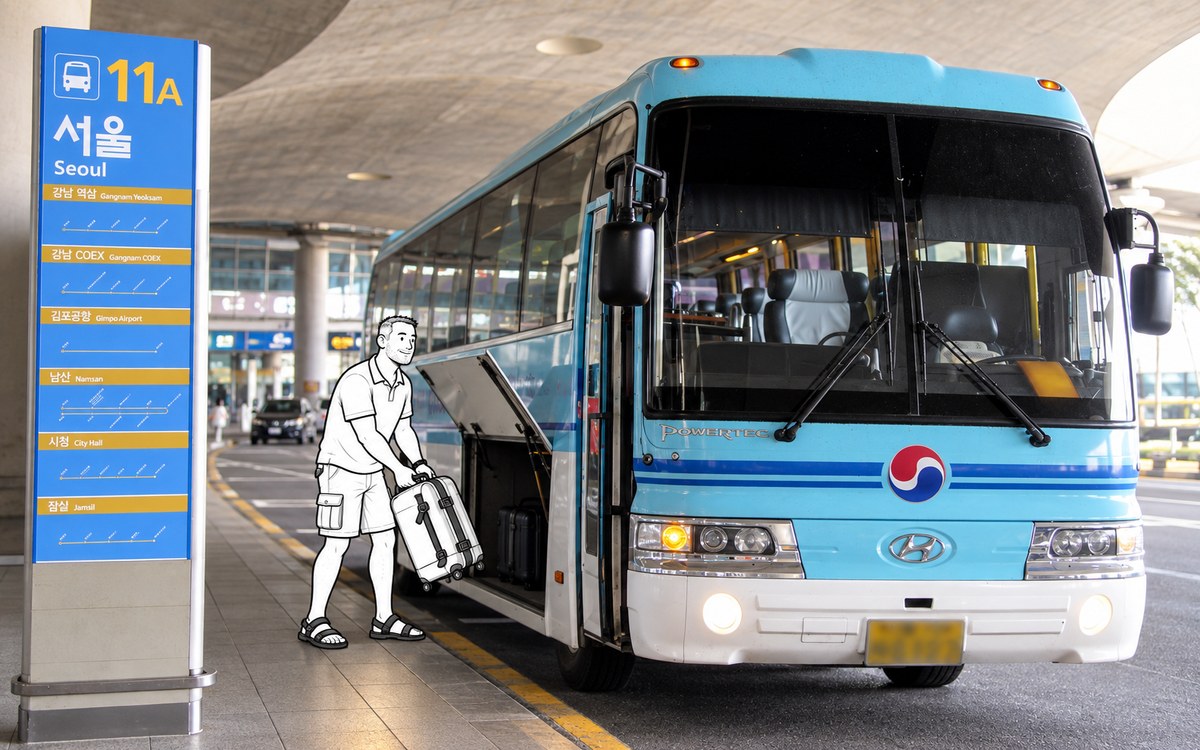
An airport limousine bus is often the calmest choice when it stops within about five minutes of your hotel. Your large suitcase goes in the luggage compartment, and you avoid long station corridors and subway transfers. This is especially useful for many Gangnam, Jamsil, Myeongdong, Dongdaemun, and hotel-heavy routes.
Airport Limousine Co. currently charges ₩17,000 for an adult on direct Seoul routes, while K Airport Limousine charges ₩18,000. Both list a ₩12,000 child fare. Buses leaving Incheon Airport use terminal ticket booths or kiosks, and the boarding point differs by route and terminal.
The bus only wins if the stop works for your hotel. Check the exact stop on the operator's route page, then map the walk with luggage. Also check the timetable shortly before travel. A bus can take roughly 60–80 minutes in ordinary conditions, but traffic can make it much slower.
Start with a route that matches your hotel
6015 toward downtown: useful for the Lotte Hotel/Euljiro side and Myeongdong Station. Use the Myeongdong transfer guide to compare stops.
6001 toward downtown: check this for Seoul Station, Hoehyeon and Myeongdong Station.
6002 toward downtown: compare stops around Hapjeong, Hongik University, Sinchon and Jongno with the All-Stop train.
On the operator's page, select the travel direction and your terminal before reading a timetable. The return stop may be different from your arrival stop.
Check the bus luggage allowance
Airport Limousine Co.'s published allowance is two bags per ticket, including carry-on baggage. Each must weigh no more than 20 kg and measure less than 160 cm when length, width and height are added together. Check with the operator before traveling with extra bags, oversize luggage or sports equipment. Other bus companies can have different rules.
Choose a taxi when the bags and transfers cost more than the fare
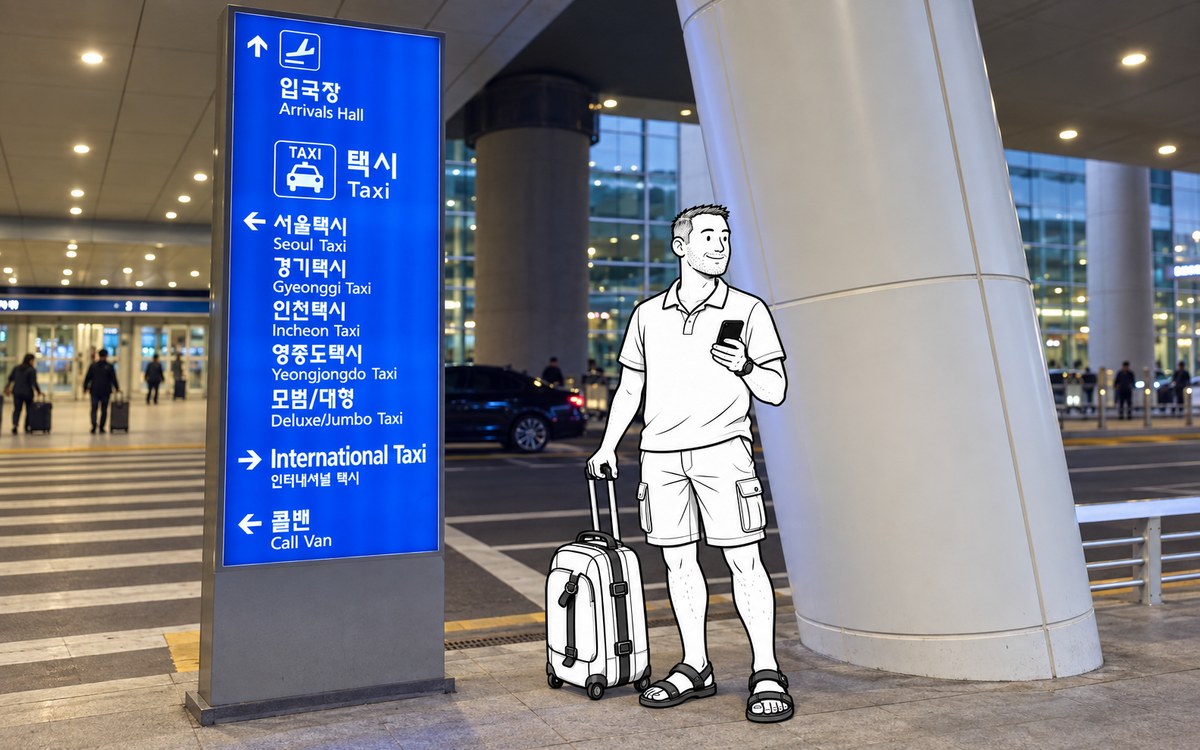
A taxi is the simplest door-to-door option for families, travelers with mobility needs, late arrivals, and groups with several large bags. Use the designated airport taxi stand or a confirmed app pickup. Incheon Airport specifically warns against illegal solicitation and vehicles posing as taxis.
A regular taxi uses the meter, and the airport expressway toll is charged separately. No boundary surcharge applies between Incheon Airport and Seoul, but a 20–40% late-night surcharge applies between 22:00 and 04:00. Make sure your group and luggage fit the vehicle; four adults with four large suitcases may need a van.
If you want a predictable official price and language support, Seoul's international taxis publish flat sedan fares of ₩70,000–₩95,000 by Seoul zone. SUV, van, and deluxe rates are ₩100,000–₩140,000. These are international-taxi rates, not estimates for every regular taxi.
Use k.ride when you want to arrange the taxi in English
k.ride is Kakao Mobility's service for international travelers. It shows an estimated fare before you request a ride, supports foreign-issued cards and mobile payments, and offers English, Japanese, and Chinese interfaces. Destination search and driver chat include broader automatic translation support.
As of August 2026, the official app listing says airport-pickup reservations are available at Incheon Airport T1 and T2, and PayPal is supported. A reservation can reduce uncertainty, but it does not remove the need to select the correct terminal, pickup zone, and vehicle size. Save your hotel name and address in both English and Korean before landing.
When is a private airport pickup worth booking?
Consider booking ahead when you need a specific vehicle size, help meeting the driver, or a pickup after your useful public-transport options finish. If you are traveling light and the train or bus reaches your hotel easily, start with those cheaper options.
One official option is Seoul's International Taxi. Its website asks for reservations at least 24 hours ahead and currently lists its midsize vehicle for three passengers and three bags. Confirm suitcase dimensions and the vehicle offered before paying, especially for a four-person group.
For any private-transfer listing or app reservation, check these details on the selected product:
Route and price: the correct airport terminal, your exact hotel, the displayed currency, and whether the price is per vehicle or per person. Confirm tolls, parking, extra stops and late-night charges.
Capacity: seats and luggage space together, including strollers or sports equipment. Ask about any child-seat requirement before booking.
Meeting point: arrivals-hall greeting or a pickup zone, how the driver contacts you, and what to do if you cannot find each other.
Flight delay and waiting: whether the operator tracks your flight, when the waiting clock starts, the included waiting time, and any extra charge.
Changes and cancellation: the deadline and its time zone, refund deductions, and what counts as a no-show.
Save the confirmation and the terms for your actual booking. A promise on another vehicle, operator or marketplace listing does not establish the terms of yours. For app setup, use the Kakao T and k.ride guide.
What should you do after a late arrival?
Do not assume the train is still running because you landed before midnight. Immigration, baggage claim, and the walk to the station can take long enough to miss the last useful train. Check the AREX timetable for your terminal, travel day and destination, then check any onward subway connection. For a bus, check the terminal-specific departure toward downtown. Use the time you expect to reach the platform or bus stop, not your scheduled landing time, and keep a taxi budget if the connection is tight.
Incheon Airport also lists Seoul night buses. The N6000, N6001, and N6002 are listed at ₩10,000 for adults, while the N6701 and N6703 are listed at ₩18,000. Routes, departure times, and terminal stops can change, so use the airport's current night-bus page rather than copying an old timetable. If no route leaves you near the hotel, use the official taxi stand or a confirmed airport pickup.
Common mistakes when traveling from Incheon Airport to Seoul
Choosing the Express for Hongdae: the Express skips Hongik University; the All-Stop train goes there directly.
Comparing only airport-to-city travel time: add the final transfer and walk to your hotel.
Checking a neighborhood instead of a bus stop: two stops labeled for the same area can leave very different walks.
Assuming k.ride is a separate transport service: it arranges a taxi, so road traffic and vehicle capacity still matter.
Ignoring the terminal: T1 and T2 have different boarding locations, journey times, and sometimes different first or last departures.
Taking an unsolicited ride: use the designated taxi stand or a booking that shows the vehicle and driver.
Which option fits your trip?
Solo traveler staying in Hongdae with one manageable bag: take the AREX All-Stop train directly to Hongik University Station.
Staying near Seoul Station: take the Express for a reserved seat and shorter ride, or the All-Stop train to save money.
Hotel next to a limousine-bus stop: take the bus and let the luggage compartment do the work.
Myeongdong, Jongno, or Dongdaemun with two large bags: compare a direct bus with AREX plus a short taxi from Seoul Station.
Gangnam or Jamsil: a direct airport bus is often easier than several rail transfers; use a taxi if your arrival is late or the stop is not close.
Three or four travelers: compare the total bus fares with one taxi large enough for everyone and the luggage.
Arriving after normal rail service: check the current night-bus route first, then use the official taxi stand or a reserved k.ride pickup.
October 1, 2026 update: rail fares and journey times, downtown-bound bus routes 6001/6002/6015, Airport Limousine Co. luggage limits, and the International Taxi booking/capacity example were checked for this update. Other sections retain their September 21, 2026 review date. Recheck the operator before booking or travel.
Related guides
Sources
Seoul Metropolitan Government: AREX times and airport transport guidance
Seoul Metropolitan Government: taxi and international-taxi fares
Kakao Mobility: k.ride registration, payments, translation, and reservations
International Taxi: vehicle capacity and advance reservations
Fares, travel times, routes, taxi rules, and k.ride features checked 2026-09-21; next review due by 2026-11-20.
Image credits: cover background, Incheon Airport Bus Stop by Sonata, CC BY-SA 3.0; AREX background, AREX station gates by Kanchi1979, CC BY 2.5; bus background, Bus Station Incheon Airport by Yerbol Nisanbayev, CC BY 3.0; taxi background, Incheon Airport T2 taxi sign by Narubaru7, CC BY 4.0. Cropped, composited, and illustrated by Korea Travel 101; the cover derivative is shared under CC BY-SA 3.0.


