
Quick summary: For a first Seoul trip of three to five days, start with Myeongdong, Euljiro, City Hall, or Jongno if your plans mix palaces, markets, and shopping. Choose Hongdae if cafes, evening plans, and the AREX all-stop train connection matter most. Choose Seoul Station when an onward KTX journey is a major part of your schedule. Insadong and Jongno remain useful for palace-focused days; Gangnam makes more sense when most of your plans are south of the Han River.
The best Seoul hotel area is not the one with the cheapest room or the most famous name. It is the area that reduces your first-trip friction: fewer confusing transfers, less walking with luggage, easier food after 9 p.m., and a simple way back when you are tired. Seoul is large, and many attractions are connected by subway, but the city still feels very different depending on where you sleep.
Best overall area: Myeongdong, Euljiro, and City Hall
If you are visiting Seoul for the first time and want the least complicated base, start your hotel search in the central zone around Myeongdong, Euljiro 1-ga to 3-ga, City Hall, and the edges of Namdaemun. This area works because it sits between many common first-trip plans: Gyeongbokgung and Gwanghwamun to the north, Namsan and Myeongdong shopping nearby, Namdaemun Market to the west, and Dongdaemun or Gwangjang Market a short ride away.
Myeongdong itself is touristy, busy, and not the most local-feeling part of Seoul. That is also why it helps first-time visitors. You will find restaurants, cosmetics shops, money exchange counters, tourist information, subway access, and taxis more easily than in a quieter residential district. If your flight lands late and you just need dinner, a convenience store, and a simple morning start, this central zone is forgiving.
Do not judge this area only by the word "Myeongdong." A hotel closer to Euljiro 1-ga, Euljiro 3-ga, City Hall, Chungmuro, or Namdaemun may be just as useful, and sometimes calmer. The key is not the neighborhood label. The key is the walk to the nearest station, whether the route has hills or stairs, and whether you can reach food without another subway ride.
Best for nightlife and cafes: Hongdae
Hongdae is a strong first-trip base if your Seoul image includes cafes, indie shops, street energy, casual restaurants, music, and late evenings. It is also practical from Incheon Airport because the Airport Railroad all-stop train serves Hongik University Station. That does not mean every Hongdae hotel is easy with luggage, but the airport connection is a real advantage if you choose a hotel near a convenient exit.
The tradeoff is distance from palace-heavy sightseeing. If your first two days are Gyeongbokgung, Bukchon, Insadong, Gwangjang Market, and Myeongdong, Hongdae adds more cross-city rides. That is acceptable for travelers who want Hongdae evenings anyway. It is less ideal for families, very early sleepers, or visitors who want a calm traditional base.
When booking Hongdae, check the exact street. A room near Hongik University Station, Hapjeong, or Sangsu can feel very different. Some streets are lively at night. That can be a benefit if you want to walk back from dinner, and a problem if you need quiet sleep.
Best for palaces and traditional streets: Insadong and Jongno
Insadong, Anguk, Ikseon-dong, Jongno 3-ga, and the wider Jongno area work well for visitors who care most about Seoul's historic core. From here, you can build easy days around Gyeongbokgung, Changdeokgung, Bukchon, Insadong, Cheonggyecheon, and Gwangjang Market. You also get a useful middle ground: more traditional atmosphere than Myeongdong, but still central enough for normal sightseeing.
The evening mood is different from Hongdae or Myeongdong. Some lanes are lively with restaurants and hanok-style cafes, but other parts become quiet earlier. That can be exactly right for travelers who want culture, walking, and slower nights. It may disappoint visitors who want shopping streets outside the hotel door.
Jongno can also be slightly harder to understand on a map because station names sit close together and exits matter. If you choose this area, pair your booking with a map app check before you pay. Search the hotel name, the nearest subway exit, and the first walking route from the airport bus or subway. A hotel that looks central but requires a long stair-heavy exit may not be pleasant after a long flight.
Best for modern Seoul and business trips: Gangnam
Gangnam is not a bad place to stay. It is just not the simplest default for a first Seoul trip. Choose Gangnam, Samseong, Yeoksam, Sinnonhyeon, or COEX if your plans are mostly south of the Han River: business meetings, clinics, shopping malls, conference venues, nightlife around Gangnam, or a hotel brand you specifically want. Gangnam also has strong airport bus and taxi options, depending on the hotel.
The drawback is sightseeing geography. Palaces, Bukchon, Insadong, Gwangjang Market, Myeongdong, and many first-trip routes sit north of the river. You can reach them by subway, but repeated rides add time and decision fatigue. If this is your first visit and you only have three or four days, Gangnam can make classic Seoul sightseeing feel more spread out than it needs to be.
A practical compromise is to stay north of the river for your first short trip, then book Gangnam on a later visit when your plans are more focused. If you have seven or more nights, splitting stays can work, but avoid moving hotels just to experience another area unless it solves a real route problem.
Seoul Station and Dongdaemun: useful, but choose carefully
Seoul Station is useful for airport rail and KTX connections, especially when an onward train is central to your plans. Check the route between your hotel and the part of the station you will actually use: the station complex is large, and being near a subway exit does not mean being next to the AREX or KTX platforms. For a late arrival or early flight, check the first or last usable service before choosing this area for its rail connection.
Dongdaemun is useful for late shopping, Dongdaemun Design Plaza, Gwangjang Market access, and hotels that can price well. It can also feel more practical than atmospheric. Some hotels are excellent for value, but check the walking route from the nearest subway exit and whether you are actually close to the station you expect. The name "Dongdaemun" covers a wider area than many first-time visitors realize.
Which Seoul hotel area should you choose?
Traveler type | Best area to start with | Why it works |
|---|---|---|
First Seoul trip, 3 to 5 days | Myeongdong, Euljiro, City Hall, Jongno | Central base for palaces, markets, shopping, food, and airport transfers. |
Nightlife, cafes, younger travel style | Hongdae, Hapjeong, Sangsu | More evening energy and a useful Airport Railroad connection through Hongik University Station. |
Culture, palaces, hanok streets | Insadong, Anguk, Jongno 3-ga | Easy access to Gyeongbokgung, Changdeokgung, Bukchon, Insadong, and Ikseon-dong. |
Business, clinics, shopping south of the river | Gangnam, Yeoksam, Samseong, COEX | Good for south-Seoul plans, but farther from many classic first-trip sights. |
KTX or one-night airport transit | Seoul Station | Useful for trains and airport rail, but check the exact street and luggage route. |
Three specific Seoul hotels to compare
Once you have chosen an area, these three hotels are practical starting points for different first-trip plans. This shortlist is based on published property information, not personal stays. It is not a price ranking: compare the same dates, room type, guest count, and cancellation terms before booking. Hotel details below were checked on October 1, 2026.
ibis Ambassador Seoul Myeongdong: a central sightseeing base
Choose it for: a first trip that mixes Myeongdong shopping, markets, and central Seoul sightseeing. The hotel's directions put it about a three-minute walk from Euljiro 1-ga Station Exit 6 on Line 2, or eight minutes from Myeongdong Station Exit 6 on Line 4. These are the hotel's walking estimates, not times from the train platform. Official location and directions.
Useful detail: Accor lists an airport limousine bus stop directly in front of the hotel, worth comparing with rail if you have large bags. Official hotel page.
Tradeoff: the standard double, twin, and triple rooms are listed at 21 m². Three beds in that space may leave little room for several open suitcases, so compare the actual room layout rather than booking on bed count alone. Official room types.
Holiday Inn Express Seoul Hongdae: airport rail and Hongdae evenings
Choose it for: cafes, shops, and evenings in Hongdae. IHG places the hotel about a minute from Hongik University Station Exit 5 and lists breakfast as included. Official hotel details.
Arrival route: take the AREX all-stop train to Hongik University. The AREX Express runs nonstop to Seoul Station and does not stop in Hongdae. Allow extra time inside the station; the hotel's one-minute estimate starts at the exit. Visit Seoul's airport-rail guide.
Tradeoff: IHG lists standard rooms across an 18–32 m² range. The smaller categories may feel tight with two large suitcases, and the category you book determines the space and beds you receive. Check the exact room description rather than assuming every standard room is the same size. Official room options.
Four Points by Sheraton Josun, Seoul Station: an onward-train base
Choose it for: a stay built around a KTX departure or an airport-rail connection. Marriott confirms an underground connection toward Seoul Station Exit 12, with access to AREX, KTX, and subway Lines 1 and 4. Official hotel and transport details.
Tradeoff: being connected to the station still involves a walk. Marriott gives an 8–15-minute estimate, so allow extra time for luggage, finding your platform, and boarding. Ask the hotel for the appropriate entrance if you arrive late or need a step-free route; an underground connection alone does not guarantee either.
October stay notice: As checked on October 1, 2026, Marriott advertises a planned power outage from 11 p.m. October 29 until 1 a.m. October 30. If your stay overlaps those hours, check the hotel's current notice and confirm the impact with the property before booking.
Check these details before paying
Your actual arrival time: if your flight lands late, confirm how late you can check in and ask the hotel to note your expected arrival. Check the last usable train or bus separately.
The room, not just the hotel name: verify floor area, beds, maximum occupancy, and whether any extra bed or breakfast costs extra for your party.
The cancellation deadline: read the terms for the exact rate and booking channel. Check the deadline's time zone, any prepayment, and the no-show charge. A hotel's general cancellation FAQ does not make every rate refundable.
The luggage route: save the hotel's address and entrance in your map app. If stairs are a problem, confirm the station elevator and hotel entrance rather than relying on the nearest numbered exit.
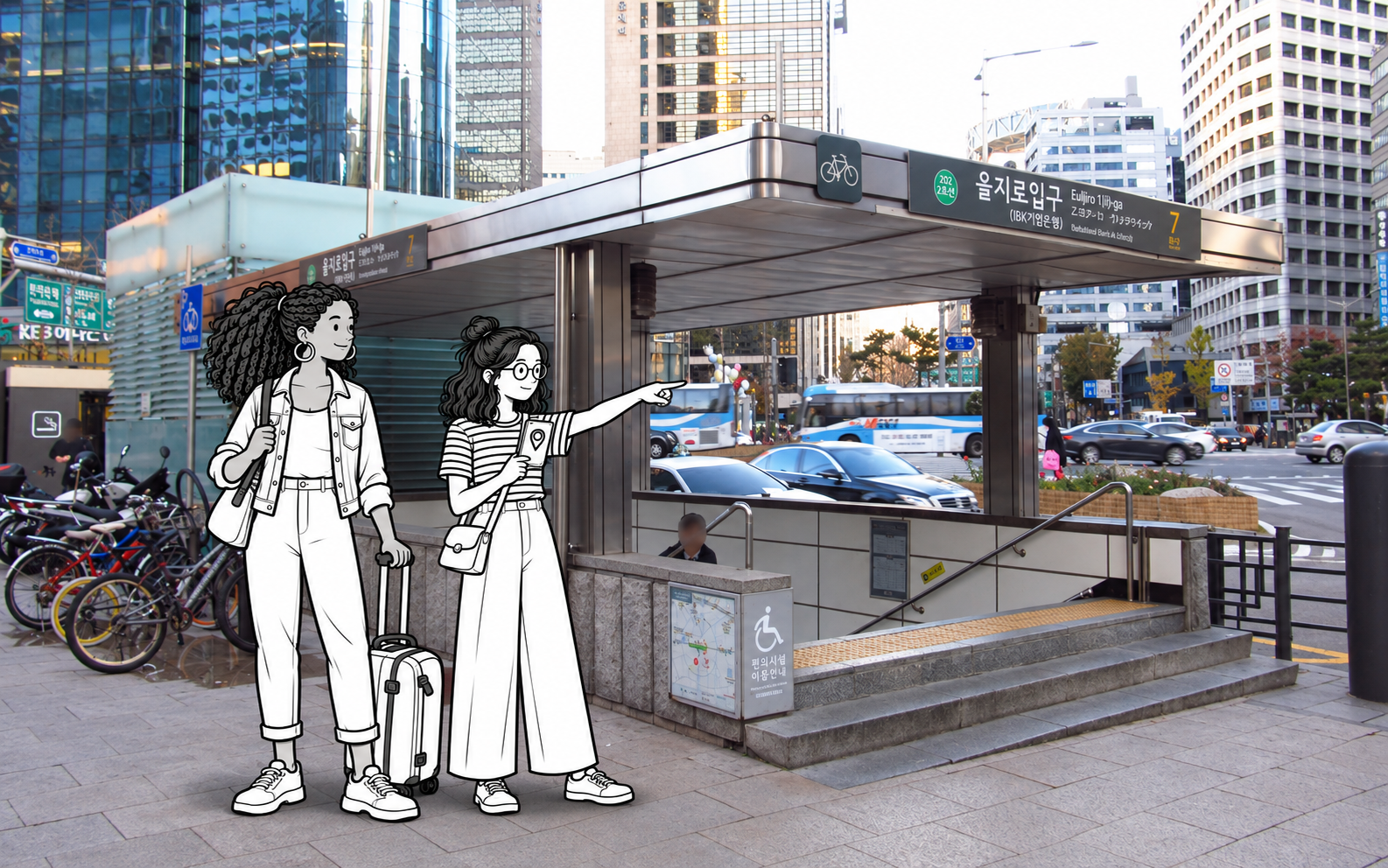
Before booking, check the walk from the station exit to your hotel entrance.
AI-assisted photo composite. Based on a 2018 photograph of Euljiro 1-ga Station exit 7. Illustrates the planning check; it does not show a particular hotel entrance or verify a current step-free route. Background: Seoul-metro-202-Euljiro-1ga-station-entrance-7-20181122-080052.jpg by LERK / Wikimedia Commons, CC BY-SA 4.0. Cropped and edited with AI-generated character overlays. This derivative illustration is licensed under CC BY-SA 4.0.
What matters more than the neighborhood name
First, check the walking route from the station exit to the hotel. In Seoul, a "five-minute walk" can still include stairs, a wide road crossing, a hill, or a confusing underground passage. This matters most when you have luggage, children, winter coats, or a late arrival.
Second, check your airport arrival plan before booking. A hotel near an airport limousine stop can be easier than a hotel near a subway station if you have large bags. A hotel near Hongik University Station can be convenient for the Airport Railroad all-stop train. A hotel near Seoul Station can be useful for the AREX Express or KTX. The best choice depends on the first and last day, not only the middle of the trip.
Third, check food within a short walk. Seoul has excellent food everywhere, but tired first-time visitors need easy food, not theoretically good food two transfers away. Search for restaurants, convenience stores, and simple breakfast options around the hotel. If you have dietary needs, do this before you pay for a nonrefundable room.
Fourth, check whether your plans cluster north or south of the Han River. Palaces, Bukchon, Insadong, Myeongdong, Gwangjang, Namdaemun, Hongdae, and Seoul Station are all north of the river. Gangnam, COEX, Apgujeong, Seongsu, and Jamsil are south or east of the core. Crossing the river is normal, but doing it several times a day can make a short itinerary feel inefficient.
Common booking mistakes
Booking Gangnam because it is famous: Gangnam is useful for specific plans, but not automatically the best sightseeing base.
Choosing the cheapest central room without checking the exit: A low price can be erased by a difficult walk with luggage.
Assuming all of Myeongdong is noisy: Some nearby streets toward Euljiro, City Hall, Chungmuro, and Namdaemun are more practical than the main shopping lane.
Assuming Hongdae is only nightlife: Hongdae also works for cafes, casual food, and airport rail, but the exact street matters.
Changing hotels too often: Seoul hotel moves cost time. For a short first trip, one good base is usually better than two average bases.
A simple recommendation
If you do not know what to choose, book central Seoul north of the Han River, close to a useful subway station and food. For most first-time visitors, that means Myeongdong, Euljiro, City Hall, Jongno, or Insadong. Choose Hongdae when evenings and cafes are a major part of the trip. Choose Gangnam when your actual plans are in Gangnam, COEX, Jamsil, Apgujeong, or south-Seoul clinics and business districts.
After you narrow the area, compare hotels by the route you will actually walk on arrival day. Put the hotel name into your map app, check the nearest station exit, and look at the path from the airport bus stop or subway. If the route looks awkward on a normal afternoon, it will feel worse after a long flight.
Related Korea Travel 101 guides
Your first 72 hours in Seoul - use this to match your hotel area to a gentle first-trip route.
AREX, airport limousine, taxi, or k.ride: best way from Incheon to Seoul - compare your airport transfer before booking a room.
Incheon Airport arrival route: from plane seat to Seoul hotel - plan your first airport hour and hotel arrival.
How to use Naver Map in Korea when Google Maps is not enough - check station exits and walking routes before committing to a hotel.
Kakao T and k.ride for foreign visitors - useful if your hotel route may need a taxi backup.
T-money, subway, and bus basics for Korea - review this before choosing a subway-heavy base.
Use the planning hub for the bigger decision
This page answers a specific travel problem. Use the related hub guide when you need the broader arrival, transport, Seoul, money, or app-planning context.
Sources
Hotel shortlist details checked October 1, 2026 against the official property pages below. This focused update does not recheck every older neighborhood statement.


