
Seoul itinerary for 3 days: palaces, markets, cafes, and neighborhoods
Quick summary: A good first-time 3-day Seoul itinerary should not try to cover the whole city. Spend Day 1 in the historic core around Gyeongbokgung, Bukchon, Insadong, and Gwangjang Market. Spend Day 2 in central Seoul with Myeongdong, Namdaemun, Namsan, and Hongdae. Spend Day 3 in a modern neighborhood such as Seongsu, Seoul Forest, Gangnam, or COEX, then keep the evening flexible. This gives you palaces, markets, cafes, neighborhoods, and enough transit practice without turning every day into a cross-city race.
This route is written for foreign visitors on a first or early Korea trip. It assumes you are using subway, walking, and occasional taxis rather than a rental car. It also assumes you want practical pacing: time to eat, time to get lost politely, time to rest at a cafe, and time to recover if rain, jet lag, or palace closing days change the plan.
Before you start: choose the right base
For this itinerary, the easiest hotel bases are Myeongdong, Euljiro, City Hall, Jongno, Insadong, or another central area north of the Han River. Hongdae also works if you care about nightlife and cafes, but it adds more rides to palace-heavy mornings. Gangnam works if you already have business or clinic plans south of the river, but it is not the simplest base for this specific route.
If you have not booked yet, compare hotel areas before locking in a nonrefundable room. The route below is much easier when your hotel is near a subway station and food. A hotel that saves money but forces long transfers every morning may not save much energy.
Before the first sightseeing day: save your hotel and route in a Korea-ready map app and arrange mobile data for your whole stay, including airport days. Our Korea eSIM comparison for trip length, data and activation timing helps you choose between LG U+, SK Telecom, KT, a physical SIM and home-carrier roaming.
Day 1: palaces, Bukchon, Insadong, and Gwangjang Market
Morning: Start with Gyeongbokgung Palace if it is open on your travel date. As of June 2026, the official Gyeongbokgung page lists Tuesday as the regular closing day, with seasonal hours and final admission changing by month. Check the official page before you go because palace hours, special openings, and event access can change.
Give the palace a real morning rather than treating it as a quick photo stop. The grounds are large, and first-time visitors usually need time to understand the gates, courtyards, museum area, and nearby Gwanghwamun. If you rent hanbok, build in extra time for changing, walking slowly, and returning the outfit. If you do not rent hanbok, palace admission is still usually inexpensive, so do not rent only for the discount.
Late morning: Walk toward Bukchon or Anguk only if you still have energy. Bukchon Hanok Village is a real residential area, not a theme park. Visit quietly, keep groups small, avoid filming private homes, and do not treat narrow alleys as a photo studio. The official Visit Seoul page notes visitor restrictions for parts of Bukchon, so treat it as a daytime, low-noise walk rather than a late-night stop.
Lunch: Move into Insadong or Ikseon-dong. Insadong is easier if you want traditional crafts, tea houses, galleries, and a calmer first-day lunch. Ikseon-dong is better if you want hanok-style cafes and more compact alleys, but it can feel crowded. Do not plan both as long stops unless your day is intentionally slow.
Afternoon: Choose one extra cultural stop, not three. Good choices include Changdeokgung, a museum near Gwanghwamun, a tea house in Insadong, or a slow walk along Cheonggyecheon. If Gyeongbokgung is closed on your day, Changdeokgung can be the main palace, but as of June 2026 VisitKorea lists Monday as Changdeokgung's regular holiday. The practical rule is simple: check palace closing days before assigning your Day 1.
Evening: Finish at Gwangjang Market if you want a direct market-food experience. The food lanes are busy, famous, and not always gentle for nervous eaters, but they are memorable. Walk slowly, look at what people are ordering, and do not feel required to try every famous dish. If the market feels too crowded, eat nearby in Jongno, Euljiro, or back near your hotel.
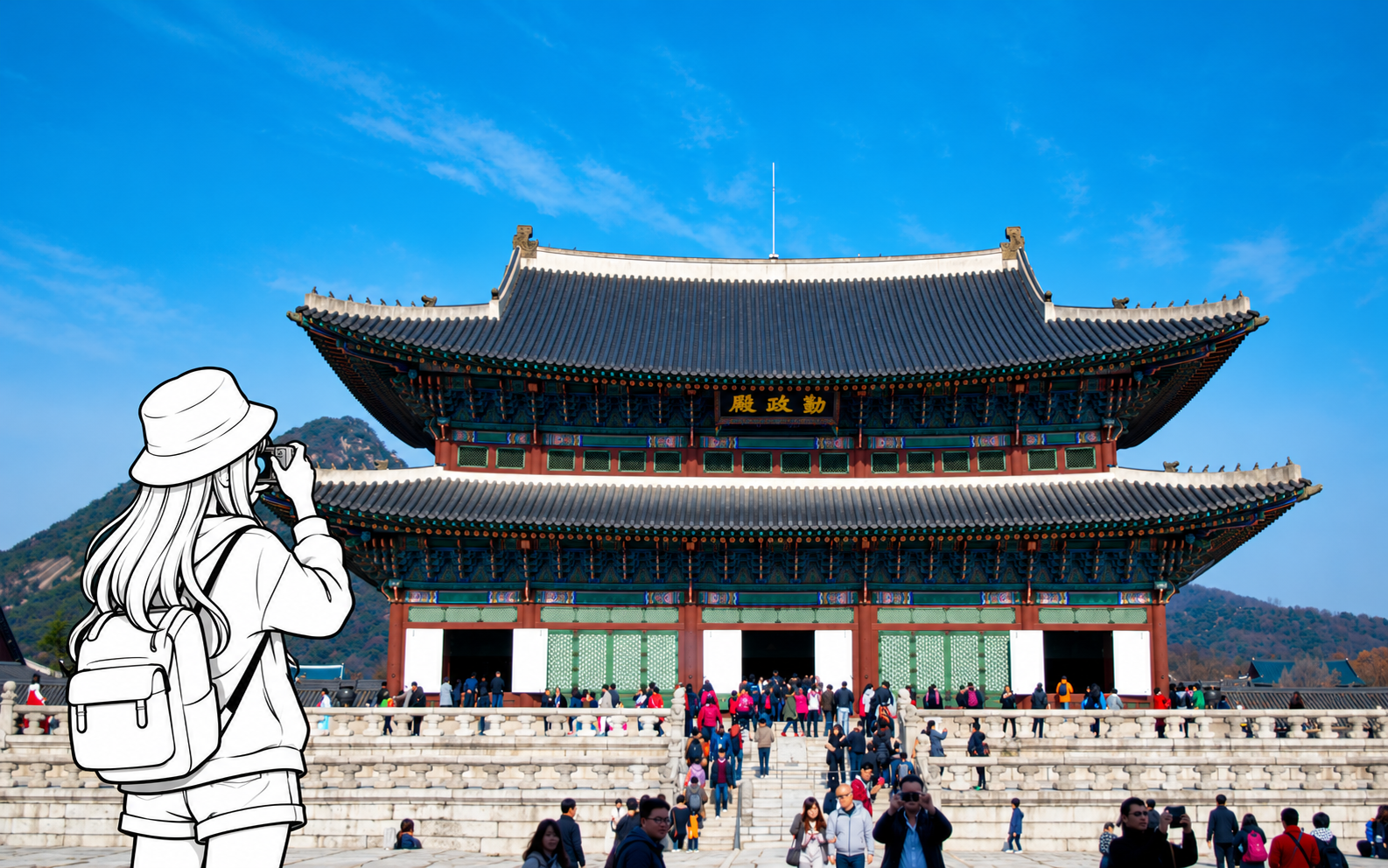
Make the palace the anchor of the day, then add nearby streets and a market at a realistic pace.
AI-assisted photo-based composite. Source photograph from 2015. Landmark illustration, not current opening-hour or ticketing guidance. Background: Gyeongbokgung(palace) Geunjeongjeon(hall).jpg by Brady Bellini / Wikimedia Commons, CC0 1.0. Cropped/reframed and edited with AI-generated character overlays; small background details may differ.
Day 1 route at a glance
Time of day | Main stop | Practical note |
|---|---|---|
Morning | Gyeongbokgung or Changdeokgung | Check closing days and final admission before leaving the hotel. |
Late morning | Bukchon or Anguk | Keep the visit quiet because Bukchon is residential. |
Lunch | Insadong or Ikseon-dong | Choose traditional-street calm or hanok-cafe energy. |
Evening | Gwangjang Market or Jongno dinner | Use the market as dinner if crowds do not bother you. |
Day 2: Myeongdong, Namdaemun, Namsan, and Hongdae
Morning: Start with Myeongdong if you are staying nearby, or with Namdaemun Market if you want a more practical local-market feel. Myeongdong is easy for cosmetics, snacks, money exchange, tourist information, and a first Seoul shopping walk. Namdaemun is better for older market lanes, household goods, food alleys, and a less polished atmosphere.
Do not make the morning only about shopping. Use it to solve practical needs: buy toiletries, find a convenience-store breakfast rhythm, withdraw cash if needed, or pick up items you forgot. First-time trips go better when the itinerary leaves room for these small tasks.
Midday: Add Namsan or a central museum depending on weather. Namsan Seoul Tower is an easy visual landmark, but the way up matters. The cable car, bus, and walking routes each have different effort levels. If the air is hazy, rainy, or very hot, consider saving the tower for evening or skipping the observatory and enjoying a lower-effort central stop instead.
Afternoon: Rest before Hongdae. This is the part many first-time itineraries miss. If you spend all day walking in Myeongdong, Namdaemun, and Namsan, Hongdae at night can feel like homework. Go back to the hotel, drop shopping bags, charge your phone, and leave again when you are ready for dinner.
Evening: Take the subway to Hongdae for dinner, cafes, shopping streets, music, or casual nightlife. Hongdae works best when you do not over-plan it. Choose a dinner area, walk a few blocks, and let the evening be flexible. If you are tired, stay near the station. If you have energy, explore toward Yeonnam, Hapjeong, or Sangsu, but keep your route back simple.
Day 2 route at a glance
Time of day | Main stop | Practical note |
|---|---|---|
Morning | Myeongdong or Namdaemun | Use this block for shopping, snacks, and practical errands. |
Midday | Namsan or indoor backup | Choose based on weather, visibility, and walking energy. |
Afternoon | Hotel rest | Drop bags and recharge before a night neighborhood. |
Evening | Hongdae | Best for cafes, casual food, shops, street energy, and late plans. |
Day 3: Seongsu cafes, Seoul Forest, or Gangnam
Morning: Use Day 3 to see modern Seoul. For many first-time visitors, Seongsu and Seoul Forest are a good balance: cafes, converted industrial spaces, shops, and a park break without making the whole day feel like a mall. Go late morning rather than too early because many cafes and shops do not need a sunrise start.
Lunch: Eat in Seongsu or move toward Konkuk University, Ttukseom, or Seoul Forest depending on your map route. If you are not interested in cafes, replace this block with a museum, Jamsil, COEX, or Gangnam shopping. The point of Day 3 is contrast. Day 1 showed palaces and older streets. Day 2 showed central shopping and Hongdae. Day 3 should show a more current neighborhood.
Afternoon: Choose one south or east Seoul add-on. COEX is useful in bad weather because it keeps shopping, food, aquarium-style attractions, and Starfield Library-style browsing indoors. Gangnam Station is better for shopping streets and dinner. Seoul Forest is better if the weather is good and you want a slower park break.
Evening: Keep the last evening flexible. You may want to return to a favorite area, buy final gifts, do laundry, pack, or eat near the hotel. If this is your last night before a morning flight, do not schedule a far-away dinner that depends on the last train. A calmer final night is often a better travel decision than one more attraction.
Day 3 route at a glance
Preference | Choose this route | Why |
|---|---|---|
Cafes and current Seoul | Seongsu plus Seoul Forest | Good contrast after palaces and markets. |
Rain or heat backup | COEX or a museum-heavy route | More indoor time and fewer weather problems. |
Shopping and nightlife | Gangnam Station or Apgujeong | Best when south-Seoul plans are part of your trip. |
Low-energy final day | Return to Myeongdong, Insadong, or Hongdae | Easy final shopping and food without a complicated route. |
How to handle palace closing days
Do not force the itinerary to start with a closed palace. As of June 2026, Gyeongbokgung's official English page lists Tuesday as its regular closing day, while VisitKorea lists Monday as Changdeokgung's regular holiday. Public holidays and special events can change the normal pattern. Check the official palace page the week of your visit, then swap Day 1 stops if needed.
If Day 1 is Tuesday, consider Changdeokgung, Insadong, Ikseon-dong, and Gwangjang Market instead of Gyeongbokgung. If Day 1 is Monday, use Gyeongbokgung, Bukchon, Insadong, and Gwangjang Market, and skip Changdeokgung. If rain is heavy, move palace time to a clearer morning and use museums, cafes, or COEX as the bad-weather block.
Transit tips for this 3-day route
Use the subway for most moves, but do not be afraid of a short taxi when it saves a tired evening. Seoul subway stations can be large, and exits matter. Before each day starts, search the exact destination, not only the neighborhood name. "Insadong" and "Bukchon" are areas; your actual route depends on the exact tea house, palace gate, market entrance, or cafe street.
Carry a transport card, some backup cash, and a charged phone. Seoul's official public transportation guidance notes that subway and bus use often depends on a public transportation card, route information, and station or bus-stop details. For first-time visitors, the practical habit is to plan the next move while seated at lunch or coffee, not while standing in a station crowd.
If you are traveling with children, older parents, or large shopping bags, reduce each day by one stop. The itinerary still works if Day 1 is only palace plus Insadong, Day 2 is Myeongdong plus Hongdae, and Day 3 is Seongsu plus final dinner. A shorter Seoul day that you actually enjoy is better than a packed route that leaves everyone frustrated.
What to skip on a first 3-day Seoul trip
Too many palaces: One main palace plus one nearby traditional street is enough for most first-time visitors.
Far-flung cafe hopping: Pick one cafe neighborhood instead of crossing the city for individual viral cafes.
Multiple night markets in one trip: Gwangjang, Myeongdong, and Hongdae already give you plenty of evening food and street energy.
Hotel changes inside Seoul: For three days, changing hotels usually wastes more time than it saves.
DMZ or long day trips: Save them for a longer Seoul stay unless the day trip is the main reason for your visit.
Related Korea Travel 101 guides
Your first 72 hours in Seoul - a gentler companion route if you want less structure.
T-money, subway, and bus basics for Korea - review this before a subway-heavy Seoul plan.
How to use Naver Map in Korea when Google Maps is not enough - useful for station exits, walking routes, and saved places.
Kakao T and k.ride for foreign visitors - use this as a taxi backup if rain or fatigue changes the day.
Incheon Airport arrival route: from plane seat to Seoul hotel - connect your itinerary to the first airport hour.
Use the planning hub for the bigger decision
This page answers a specific travel problem. Use the related hub guide when you need the broader arrival, transport, Seoul, money, or app-planning context.
More practical regional guides
Use these related Korea Travel 101 guides when you want a more specific route, attraction, or regional itinerary.


_Geunjeongjeon(hall).jpg)