
Quick summary
What to do first
For most foreign visitors, k.ride is the simpler first taxi-app choice when overseas card registration or social login matters. Kakao T is useful if you already have a working Kakao account and can handle its payment or pay-to-driver flow.
Best next step: Set up one taxi app before arrival, save your hotel name in Korean, and confirm the pickup point before requesting a ride.
Check before acting: Taxi-app availability, payment options, and pickup behavior can change by app version and taxi supply.
Fact and structure review: 2026-06-05.
Taxi apps reduce language friction, not every problem
Kakao T is Korea's dominant taxi and mobility app, while k.ride is described by VisitKorea as a foreigner-accessible version connected to Kakao Mobility services. These apps can make taxi rides easier because you can enter destinations in the app, see driver movement, choose taxi type, and reduce spoken communication. But they do not remove every travel problem. Payment setup, pickup location, taxi type, luggage, and app account issues still matter.
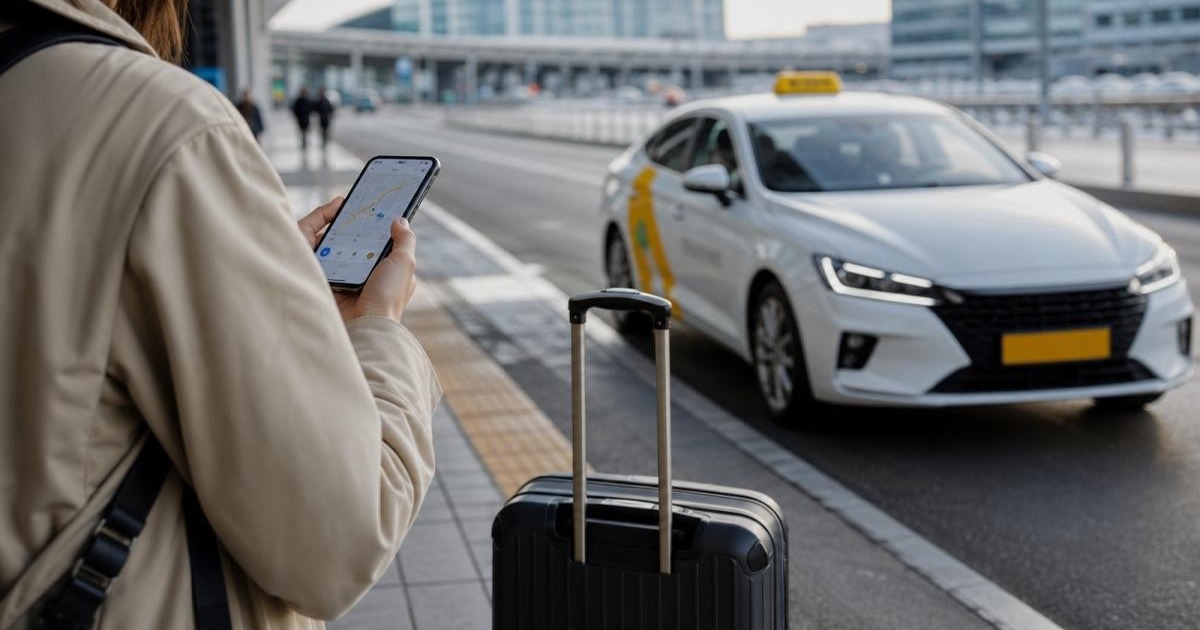
This guide is for visitors who want to use taxi apps during a Korea trip without turning every ride into a technical experiment. The safest habit is to set up your app before you need it urgently.
Which app should you try?
Option | Good for | Check first |
|---|---|---|
Kakao T | Broad local taxi coverage and common Korean use | Account setup, language, and payment options for your phone/card. |
k.ride | Foreign visitors who want simpler access and overseas card registration where supported | Service area, taxi type, and pickup flow. |
Uber Taxi | Travelers familiar with Uber interface | Availability and whether it dispatches local taxis in your area. |
Official taxi stand | Airport, station, late-night backup | Destination address in Korean and fare awareness. |
Set up before the first ride
Install the app before leaving home or while on stable Wi-Fi.
Check whether your phone number, social login, or email can complete account setup.
Add a payment method if the app supports your card.
Save your hotel as a destination in Korean and English.
Test a route estimate without booking.
Learn the taxi types before choosing one under pressure.
Do not wait until midnight outside a bar, airport, or station to discover that your app cannot verify your account. If the app setup fails, you still need a backup plan: official taxi stand, hotel front desk, airport information desk, or public transport.
Payment choices
VisitKorea's ride-hailing guidance notes that travelers may use options such as paying by cash, credit card, or Tmoney directly to the driver, or auto-pay where supported. The exact options can differ by app, account, card, and taxi. If your app shows pay-to-driver, confirm that you have a usable card or cash. If auto-pay is available, still carry a backup card. Do not assume every driver can solve a foreign-card problem at the end of the ride.
Pickup points matter
Most taxi app problems are not about the taxi. They are about the pickup point. Airports, big stations, department stores, and nightlife districts may have multiple roads, levels, exits, and pickup zones. If you request from the wrong side of the street, the driver may arrive but not find you. Check the pin carefully, look at the road direction, and use a visible landmark. At Incheon Airport, follow official pickup and taxi-stand guidance instead of dropping a random pin.
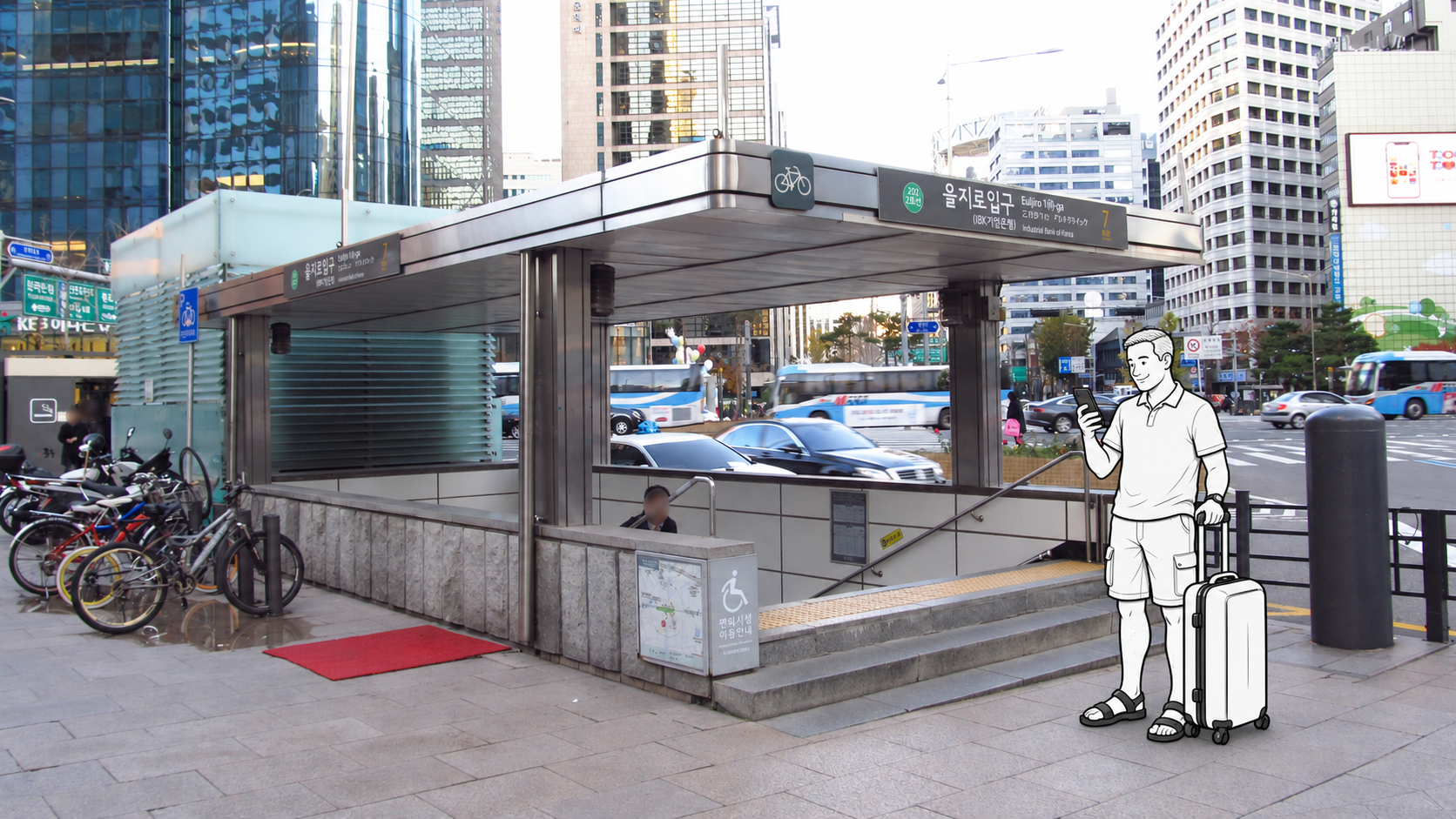
Check the pickup pin, road direction, and a visible landmark before requesting your taxi.
AI-assisted photo-based composite. This station frontage is an illustrative landmark, not a verified taxi pickup zone. Historical photo; do not treat as current wayfinding. Background: Seoul-metro-202-Euljiro-1ga-station-entrance-7-20181122-080052.jpg by LERK / Wikimedia Commons, CC BY-SA 4.0. Cropped/reframed and edited with AI-generated character overlays; small background details may differ. Derivative illustration under CC BY-SA 4.0.
Taxi type and luggage
A regular taxi is fine for one or two travelers with small bags. If you have large suitcases, a stroller, golf bag, or group of four, choose a larger option where available or use an airport bus. Do not expect a regular taxi trunk to solve every luggage problem. If you are traveling with children or older travelers, the most comfortable ride may be the one that reduces loading, transfers, and walking, even if it costs more.
What can go wrong
The app account cannot verify your phone or login.
Your foreign card is not accepted for auto-pay.
The pickup pin is on the wrong road or level.
The driver calls or messages in Korean and you cannot respond quickly.
You choose a taxi too small for luggage.
You request from a place where taxis cannot stop easily.
How to reduce Korean-language friction
Keep your destination address in Korean. A hotel name in English may not be enough if there are similar branches. Use Naver Map to copy the Korean address, or ask the hotel to send it. If a driver calls, use simple phrases or message through the app if available. Papago can help, but do not rely on live translation during a fast pickup moment. Better preparation beats better improvisation.
Best use cases
Taxi apps are most useful for late-night neighborhood moves, awkward hotel routes, rainy days, luggage transfers, family travel, and places that are not easy by subway. They are less necessary for simple subway-friendly routes during normal hours. In central Seoul, the subway is often faster and cheaper. Use taxis strategically, not automatically.
Connect taxi apps to the rest of your trip
Taxi apps are most useful when they are a backup inside a wider arrival, payment, and navigation plan.
Use the planning hub for the bigger decision
This page answers a specific travel problem. Use the related hub guide when you need the broader arrival, transport, Seoul, money, or app-planning context.
Bottom line
Kakao T, k.ride, and other taxi options can make Korea travel much easier, but only if you prepare the app, payment, pickup point, and destination before stress hits. Set up early, save Korean addresses, carry backup payment, and know when public transport is still the better choice.


