
Quick summary: A DMZ tour is a controlled, source-sensitive day trip, not a normal attraction you can plan from old blog posts. Most first-time visitors book a guided route connected to Paju, Imjingak, the Third Tunnel, Dora Observatory, and related stops. JSA or Panmunjom access can change separately from ordinary DMZ-area tours, so check official and tour-operator rules close to your travel date and bring your passport.
Best for: travelers interested in modern Korean history, division, and border context.
Check first: current access, passport rules, tour route, cancellations, and whether JSA/Panmunjom is included or unavailable.
Do not assume: every “DMZ tour” enters the same areas or includes the same restricted sites.
Short answer: is a DMZ tour worth it for first-time visitors?
A DMZ tour is worth it if modern Korean history is a meaningful part of your trip and you understand that access is controlled. It is not the easiest casual sightseeing day, and it should not be booked from vague assumptions. The usual visitor experience often centers on Paju-area DMZ tourism, Imjingak, the Third Tunnel, Dora Observatory, and controlled routes, but exact access can change.
If you want a broader planning frame, use the Korea regional travel guide and Seoul first-time visitor guide before deciding whether to spend a day on the DMZ.
DMZ tour terms visitors confuse
Term | What it usually means for visitors | Planning caution |
|---|---|---|
DMZ tour | A controlled tour around DMZ-related attractions, often near Paju and Imjingak | Routes vary by operator and conditions. |
Third Tunnel | A major Paju DMZ-related stop described by VisitKorea | Access and route procedures are controlled. |
Dora Observatory | An observatory area associated with views toward the border region | Weather and access affect the experience. |
JSA / Panmunjom | A more sensitive Joint Security Area experience | May be unavailable even when other DMZ tours operate. |
Imjingak | A public-facing park and tourism area connected to DMZ routes | Not the same as unrestricted DMZ entry. |
Check JSA and Panmunjom separately from ordinary DMZ tours
Checked October 1, 2026: the Ministry of Unification's Panmunjom visitor information says its tour program for foreign visitors is not operating. The Korean-language homepage also carries a suspension notice for general tours. Do not build your itinerary around a JSA visit unless current official guidance and your operator confirm access for your date.
A Paju DMZ tour covering the Third Tunnel and Dora Observatory does not include entry to Panmunjom simply because “DMZ” appears in its name. A “JSA Museum” stop is also different: VIP Travel describes its museum as an interactive experience in Unification Village. Check the actual stops, not just the product title or photographs of blue conference buildings.
Bring your original passport and check the operating day
For an overseas visitor, bring your original, valid passport. Paju's visitor rules reject ID copies and photographs; they also list alien registration cards among accepted documents for foreign residents. Check your operator's requirements before relying on an alternative to a passport.
The Paju DMZ Peace Tour normally closes on Mondays, weekday public holidays, and the days of Seollal and Chuseok. Security or weather conditions can stop visits without advance notice, including reserved visits. Check both the city notice and your booking confirmation close to departure.
Keep your passport accessible, stay with the group, and follow staff directions. Ask before taking photographs: Paju publishes photography and video restrictions for the controlled tour route.
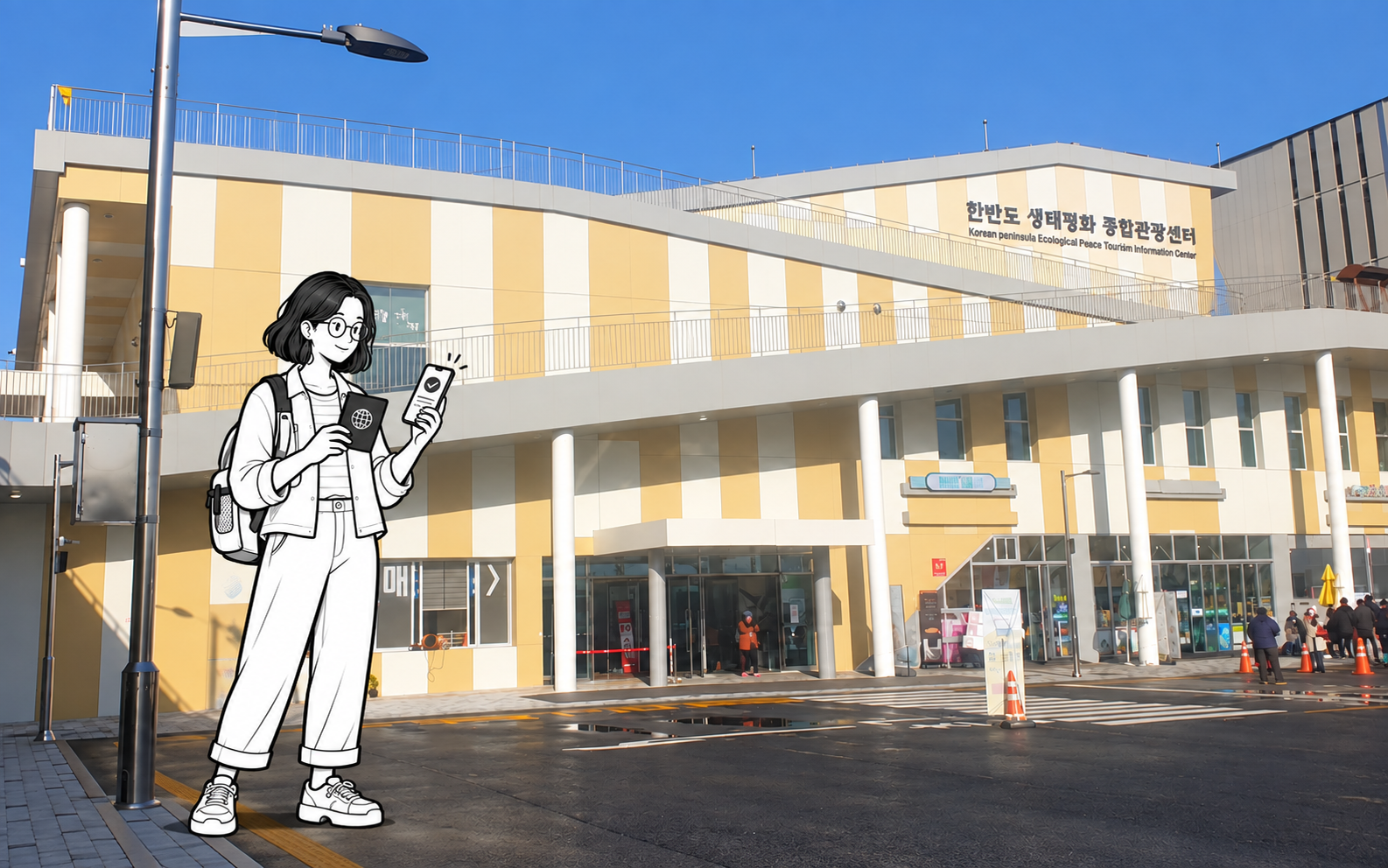
Have your original passport and booking confirmation ready for your DMZ tour.
AI-assisted photo composite. Imjingak public tourism-center setting, not a military checkpoint or passport inspection. Background: 임진각 관광센터.jpg by KSH1015 / Wikimedia Commons, CC BY-SA 3.0. Cropped and edited with AI-generated character overlays. This derivative illustration is licensed under CC BY-SA 3.0.
Is the Third Tunnel suitable for you?
The tunnel is a physical part of the day. Paju warns that narrow passages and a steep incline can prevent visitors with limited mobility from entering. Before paying, ask whether you can skip the underground walk and where you would wait.
Do not assume your ticket includes a monorail. VisitKorea lists walking and monorail options, but the option available through your tour may differ. Wear comfortable walking shoes and discuss any accessibility needs directly with the operator.
Compare English-guided DMZ tours from Seoul
Start with a standard Paju route if your main interest is the history and border context. Choose a suspension-bridge extension only if you also want an outdoor stop and a longer day. The examples below come from the operator or booking merchant's own pages, checked October 1, 2026. They are itinerary comparisons, not guarantees that every listed stop will open.
Seoul City Tour: standard DMZ tour
Check the standard tour and its options
Choose it for: a history-focused route with an explicit no-shopping policy
Listed stops: Imjingak and Freedom Bridge, Third Tunnel, DMZ Theater and Exhibition Hall, Dora Observatory, and a drive past Unification Village
Meeting and return: meeting points in Myeongdong, City Hall, or Hongik University Station; return to City Hall. Hotel pickup and drop-off are excluded
Time: advertised schedules of 08:00–14:00 or 10:00–16:00, about six hours
Included: English-speaking guide, transport, and DMZ admission. Meals cost extra; the defector meet-up is an optional add-on
Seoul City Tour: DMZ with Gamaksan Suspension Bridge
Check the Red Suspension Bridge tour
Choose it for: the Paju stops plus a mountain suspension bridge
Time: advertised 08:00–16:00 schedule, about eight hours
Meeting and return: Myeongdong, City Hall, or Hongik University Station; return to City Hall
Included: English-speaking guide, transport, and DMZ admission, with no shopping stops. Meals and hotel transfers are excluded
Physical demand: the operator describes the bridge visit as moderate hiking, in addition to the tunnel's steep walking route
Trazy: morning or afternoon DMZ tour
Check the morning and afternoon options
Choose it for: a designated pickup near your Seoul accommodation; late bookings use Hongik University Station Exit 3
Listed route: Imjingak, Third Tunnel, DMZ Theater and Exhibition Hall, Dora Observatory, Dorasan Station, and a drive past Unification Village
Time: the sample schedules extend from 07:30–08:00 pickup to 14:00–14:30 return, or 10:00–10:30 pickup to 17:00–17:30 return. Confirm your exact timing rather than relying on the six-hour headline
Included: English-speaking guide, transport, and admission. Lunch is excluded; this tour does not use the tunnel monorail
Check cancellation terms before choosing a tour
A free-cancellation badge does not explain what happens when the route changes after departure. Ask two questions: “What is my cancellation deadline?” and “What happens if the military closes the planned sites?”
Trazy's listed policy gives a full refund for cancellation by 17:00 Korea time three days before the tour. For military closures announced before the tour, it offers an alternative or a full refund; closures decided on the day result in substitute stops without a refund.
Seoul City Tour's product pages and general cancellation policy show different customer-cancellation cutoffs. Ask which deadline applies to your booking and save the answer. Its general policy promises a full refund when the operator cancels for weather, safety, or operational reasons; that is separate from a tour that still runs with changed stops.
Before checkout, compare the final total for the same date, route, and add-ons. Check the exact meeting point, meal arrangements, shopping policy, and return location. Keep your evening flexible and avoid scheduling this trip on your airport-departure day.
Common DMZ tour mistakes
The first mistake is assuming every tour includes the same sites. The second is booking because “DMZ” sounds famous without understanding what you will actually see. The third is forgetting passport or operator rules. The fourth is assuming JSA/Panmunjom access is available because an old article or review mentioned it.
The fifth mistake is planning a tight evening reservation after a controlled day trip. Delays, traffic, and procedure changes can happen, so keep the evening flexible.
FAQ
Can I visit the DMZ without a tour from Seoul?
You can arrange your own journey to Imjingak and use Paju's controlled DMZ Peace Tour, subject to tickets and access rules. Paju says this service does not provide a separate guide. An English-guided package from Seoul can make transport and explanations easier, but it is not the only way to arrange the Paju route.
Does every DMZ tour include the JSA?
No. A standard Third Tunnel and Dora Observatory tour is separate from JSA/Panmunjom access. As checked October 1, 2026, the official Panmunjom foreign-visitor program is not operating. A JSA Museum or photo experience is not entry to the JSA.
Should I bring my passport?
Yes. Bring the original, valid passport and follow the identification instructions in your booking confirmation. Do not rely on a photo or photocopy.
Does “half-day” mean I will be back for lunch?
No. Compare the actual pickup and return schedule. The examples above take much of the day, and access procedures or traffic can delay the return.
Sources
Tour choices, access rules, and booking cautions checked October 1, 2026. Confirm current availability and the exact terms attached to your booking before paying.


